 |
| Miyamoto Musashi confronts Sasaki Kojiro at the start of their fateful duel (from the 1973 film Miyamoto Musashi) |
An understanding of distance is a fundamental part of bujutsu, but it is perhaps one of the most difficult to understand. Although it involves physical distance, it includes (at the very least) consideration of subtle angles and adjustments based on timing and an appreciation of the range of the weapons used by both combatants.
The paired kata of Japanese bugei include aspects of this, but some of the finer points may not be grasped by even quite advanced practitioners. They were designed to be absorbed rather than to be explained, and it may be that specific explanations are a recent addition to teaching – few modern practitioners have the luxury to immerse themselves so deeply that these relationships are fully revealed. Nor is there the same sense of necessity. Even though many of these kata were developed and passed on in times of relative peace, training was more severe than it is today.
This control of distance was an aspect of his art for which Miyamoto Musashi was particularly well known, and an understanding of which was key to his famous duel with Sasaki Kojiro. Even if no-one can really be sure what happened, a careful analysis of what we do know provides interesting insights into some of the possibilities.
Although Musashi did not write of his fights, his writing contains references that may have a basis in specific experiences, as well as explaining broader principles. In The 35 Articles of Strategy, he wrote:
There are a number of different ways of covering distance according to established theories of heiho. Here I am speaking of something different. Whichever way it may be, it is something you will learn by much repetition. Speaking generally, you should be aware that when you can strike someone with your sword, you may be struck by their sword. When you wish to strike someone, you must forget about yourself. You should investigate this thoroughly.
(Author’s translation)
Kojiro was skilled with a particularly long sword, a skill he had developed, it is said, through acting as chief training partner to his master, Toda Seigen. As Seigen’s specialty was the short sword, it might seem strange that Kojiro used a sword that was longer than the norm. The reason, it is said, is that in refining his skill, Seigen had Kojiro use an increasingly long blade. Thus Kojiro’s skill with a long sword developed as his master’s technique grew ever better.
 |
Toda Seigen –
Teacher of Sasaki Kojiro |
Part of the skill he developed was the ability to keep another swordsman at bay with the length of his sword. Length itself is no guarantee of victory, but Kojiro had also developed an extreme sensitivity and ability to rapidly change the direction of his sword stroke, unusual in a weapon so long, all of which made him an extremely difficult adversary.
Musashi would have been aware of Kojiro’s famous ‘returning swallow’ technique (tsubamekaeshi), and he staked the results of their encounter on his ability to overcome this technique. Whatever the precise nature of the technique (and there is some argument about it, although the most likely seems to be a feint and attack or combination attack) it was clear that it made use of the length of the blade and that Kojiro was also used to dealing with attempts to move inside.
Instead, Musashi chose to remain at the very edge of Kojiro’s range and defeat him with a weapon that was just a fraction longer than Kojiro’s sword. The popular story is that he carved a wooden sword from a boat’s oar as he was being rowed to the site of the duel, but it is far more likely that he had already decided on and made the weapon he was going to fight with well before the duel. After all, if his strategy depended on a slight length advantage, he would want to make sure he had got it right.
Musashi had faced long weapons before – according to the Kokura monument (erected by Musashi’s adopted son in 1654, less than 10 years after Musashi’s death, and generally considered reliable) Yoshioka Denshichiro used a wooden sword five feet in length against him – and even if the story of his duel at the Hozoin Temple is discounted for lack of evidence, a well-verified account of a later, friendly, duel with the spear expert, Takada Matabei, shows Musashi was skilled at getting inside the perimeter of a longer weapon. That he chose a different strategy attests to Kojiro’s skill.
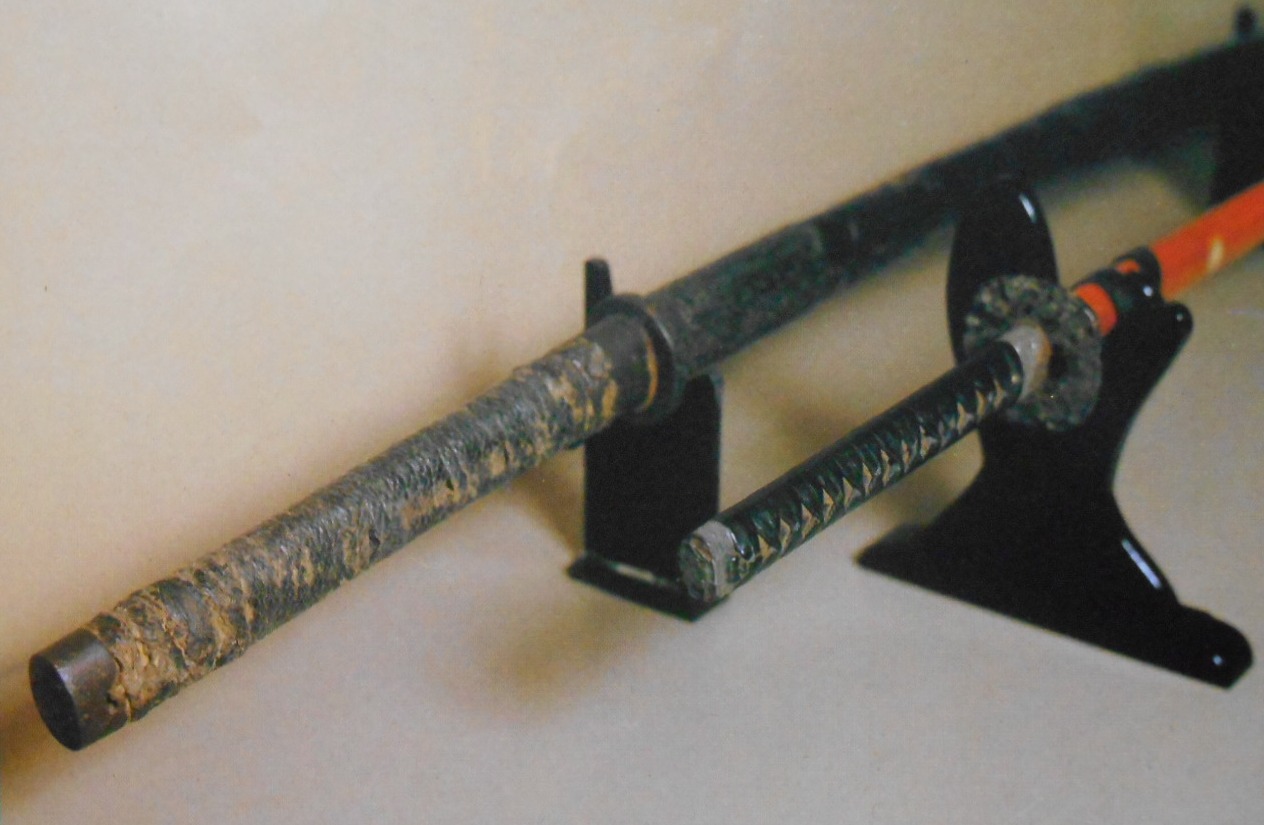
According to the Kokura Monument, Kojiro’s sword (named Drying Pole/Laundry Pole – Monohoshizao) was 3 shaku (about 90cm, plus the hilt, to give a total of something like 114 cm in length). Although the wooden sword Musashi used no longer survives, there are (at least) two surviving wooden swords he was said to have carved at a later date in response to enquiries about the duel. One of these is in the Matsui Collection, and was given by Musashi to Matsui Yoriyuki (the adopted son and heir of the Hosokawa vassal who acted as host to Musashi during the period of his duel with Kojiro). Given the relationship he had with the family, (and the fact that the Matsui Collection includes a number of other items made by Musashi) it is likely that this is genuine. It looks similar to a regular bokken in shape, but is rather larger – 127cm (4 shaku 2 sun), which would make it a little longer than Kojiro’s sword.
 |
A picture of Musashi's bokken from the
Matsui collection, with a regular sized
bokken below – the two photos are very slightly
out of scale, but not by much |
Another, and slightly different looking bokken exists in the care of Kato Isao of the Shunpukan Dojo in Nagoya. Among other styles, he teaches Enmei Ryu, which was the style Musashi taught in his younger days. The bokken came down from Tachibana Minehira, who was a grand-student of Musashi in the Chikuzen line of the Niten-ichi Ryu and author of the Bushu Denraiki(one of the important source documents on Musashi) and was passed to Kato as a suitable guardian by the Tachibana family.
 |
Kato Isao shows the other Musashi bokken on Japanese TV
|
 |
One of Kato's students, (grand-student?), Akabane Daisuke
wielding a bokken modelled on the Musashi bokken above. |
The Duel
The traditional story has Sasaki Kojiro waiting on the island for Musashi, who turns up late, as he had done in previous duels. This time, he arrives in a small boat and leaps into the waves as the boat comes toward the beach. The two face off, and Kojiro draws his sword from its saya, which he casts into the waves. Musashi taunts him, saying this move shows he knows he is beaten. The two set to it, Kojiro now angry. They strike simultaneously, and while Musashi’s headband is cut, Kojiro is struck down. Musashi approaches the body and Kojiro strikes from the ground; Musashi leaps back, his hakama cut, and strikes Kojiro once more, with a blow that finishes him. Musashi then escapes on the boat he arrived in, making use of the tides to avoid pursuit.
Despite the unreliability of this account, there are elements that offer insight into the use of distance in Musashi’s strategy. Firstly, by jumping into the waves, Musashi was able to hold his bokken with the tip in the water, hiding its true length and denying Kojiro the chance to change his tactics. As he advanced, it is likely he would have kept his sword behind him, either holding it low or resting on his shoulder. In both these positions, the tsuka (hilt) would have been pointing directly at Kojiro, preventing him assessing the length of Musashi’s weapon.
Whether or not Musashi provoked Kojiro by his comment, it is likely Kojiro would have cast aside his long saya in any case to allow him to fight unencumbered. Perhaps Kojiro was angered, but if Musashi made such a comment, it can only have been to harden Kojiro’s intention to use his favourite technique, tsubamekaeshi, on which Musashi had based his strategy.
There is some reason to believe that this technique utilised the tip of the sword, thus Musashi could stay outside Kojiro’s range and strike using the extra reach of his specially designed bokken only if he came very close to the edge of Kojiro’s range and struck before the 'return' part of the 'returning swallow' could come into play, which considering Kojiro's skill, would mean that the two blows would be almost simultaneous. In the event, he played it very fine indeed, Kojiro’s blade coming close enough to slice through his headband.
Kojiro’s counter was supposed to have been wickedly fast, but Musashi’s understanding of rhythm and range – his mikiri– was exceptional. It must have been, for despite the difference in weight, a wooden sword is no match for a real blade in speed. He invited Kojiro’s attack, and at the very moment Kojiro thought he had cut him, it was Musashi who struck home, using that infintessimal advantage in timing and distance to the fullest.
Musashi’s blow was timed to the instant Kojiro cut – if he had slipped the blow and got inside, he would not have needed a longer weapon. If he had waited even a fraction of a second longer, Kojiro would have countered. Thus he aimed for Kojiro’s greatest weakness, which was also the point of greatest danger. The advice in 35 Articles of Strategy seems to be written with this in mind:
… you should be aware that when you can strike someone with your sword, you may be struck by their sword.
Kojiro seems to have been lost in history, his name preserved in the tale of his final adversary. The site of his death also bears his name, Ganryujima. Even this, though, may not be as straightforward as it seems: it has been suggested that this may have originally referred to the island directly – ‘the rock in the current’ is a possible translation of Ganryu. But despite the lack of hard information about him, details of the story ring true, making an analysis like this more than simple academic. If undertaken seriously, it can bring a greater understanding of the factors a swordsman would want to have under control if he was to stake his life on a duel such as this.




 Posts
Posts


