Showing posts with label Hirayama Shiryu. Show all posts

Tuesday, 20 May 2025

Short Swords - tantô-chokunyû (単刀直入) – getting straight to the point


Still from the movie Sekigahara (2017) – good use of a short sword.


The katana is, perhaps, the sword most closely associated with the samurai, but it is worth remembering that the short sword was a consistent part of the equipment of the bushi class throughout their history, and the exclusive right to bear two swords became a defining privilege of that class during the Tokugawa period. It was worn in many situations where the longsword would typically not be worn for reasons of practicality or security, yet it typically formed a lesser part of a warrior’s training.

One of the memorable chapters in the Heike Monogatari has Taira Tadamori show his cunning and foresight to foil an assassination attempt in the palace precincts by displaying a short sword to dissuade his would-be attackers.

 Swords seemed to have been central to training in many schools of bujutsu, although it is generally acknowledged that other weapons were more widely used on the battlefield. Swords had a deep cultural resonance going beyond mere practicality, also having religious and ceremonial uses, and perhaps this was why they were used as a vehicle for technical and theoretical development of basic principles and skills of combat that could be applied to a number of weapons.

 Nevertheless, specific skills for using the short sword were taught, often in conjunction with jujutsu or similar techniques of body control. The short sword was especially effective in situations where space was limited (such as indoors) or where surprise was a key element. Control of distance and line of attack were especially important, and the ease with which a short sword may be wielded with one hand leaves the other free for controlling the opponent.


The inherent disadvantage of the short sword when facing longer weapons could also be used to refine certain skills. Toda Seigen, reputedly the teacher of Sasaki Kojiro, Miyamoto Musashi’s famous opponent, was famous for his use of the short sword. Kojiro developed his skills with the extra-long sword from being a junior training partner for Toda as he further refined his short sword skills. (If you're interested, I wrote some more about that here).


Similarly, some two hundred years later, the eccentric swordsman Hirayama Kozo had his own students train in the short sword while facing an opponent with an extra-long sword to develop their spirit.


Hirayama wrote:

My swordsmanship is for slaying the enemy brutally. You must use this feeling of ferocity to penetrate directly into the enemy’s heart and mind. (Kensetsu – Sword theory)


Interestingly, one of his students had the chance to test this with a master of the Fuden Ryu, Kawakami Danemon, who came to try his skills against Hirayama. This Fuden Ryu, which has connections with the Asayama Ichiden Ryu (which has lately become well-known on Youtube), also has interesting teachings regarding the short sword, perhaps stemming from the teachings of the founder, who was a bodyguard for Tokugawa Ieyasu.


In this case, Hirayama was out, so his student, Soma Daisaku, took the challenge. The challenger used a long sword (the account I read says it was 6 foot shinai, although I assume the original measurement was shaku) while Daisaku had a short shinai - 1 shaku 3 sun (about 15 inches) in length. They faced off but Daisaku gradually forced his opponent back. When his opponent tried to counter, Daisaku’s thrust sent him into the wall. (I also wrote about Hirayama and Daisaku here.)


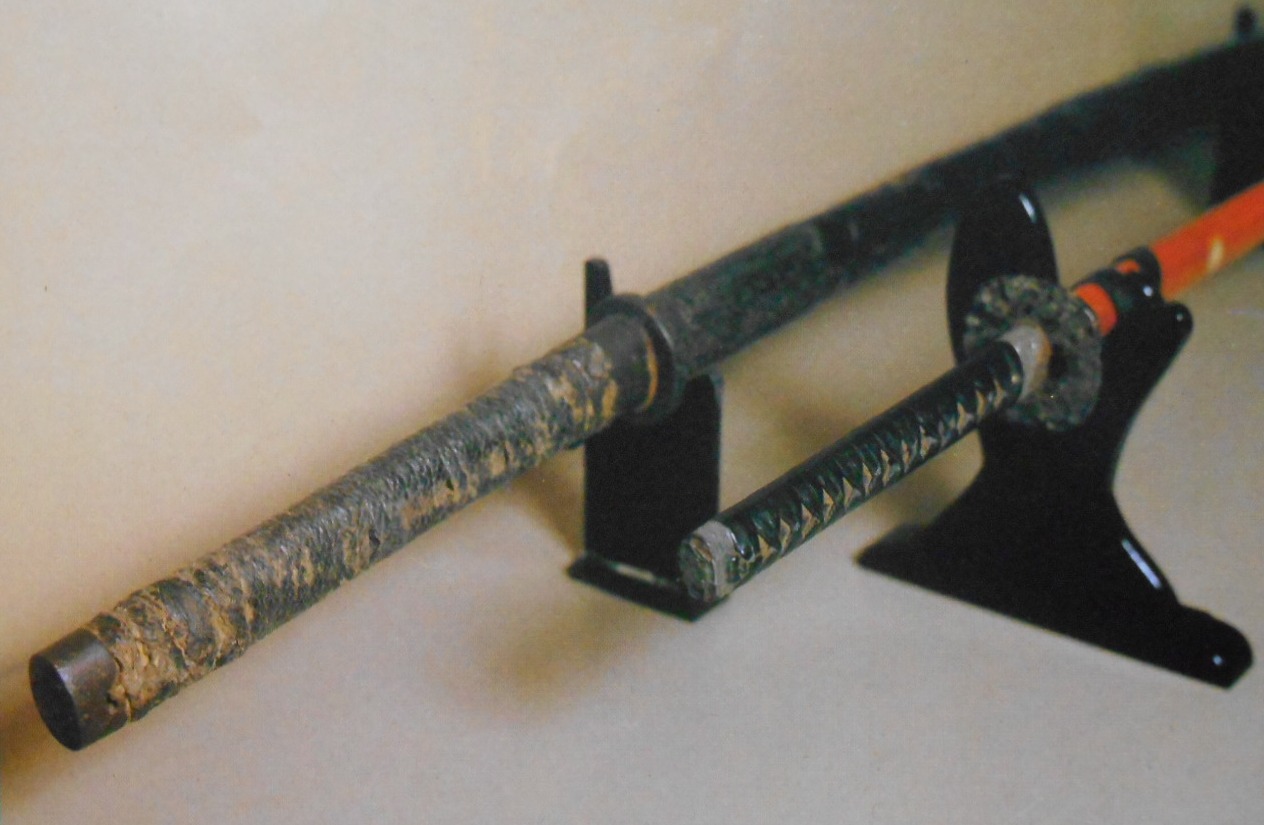
The sword in a red saya is Daisaku's normal sword
The longer one is an extra large one he used for practice.
Courtesy of https://japanbujut.exblog.jp/24646197/


(This is to say nothing of the relative merits of the two schools per se. There is still a school of the Fuden Ryu, though this is not to be confused with the sojutsu school of the same name – the two are written with different characters).


While I'm on the subject, the short sword also plays an important part in my new novel, Fallen Blossom, Book 2 of the Oshima Tokyo Noir series. 


If you like murder, mystery and martial arts, and a bit of not too distant history – it’s set in 1930’s Tokyo – this could be the book for you! It’s available as an ebook on most major online book sellers, including Apple Books, Kobo and Amazon, from today (May 20th) and it’s at a discount price until May 27th.


This link will take you to the non-Amazon sites (and probably Amazon after today).

Fallen Blossom


If you shop at Amazon.com, this link will take you direct to the page. 

Fallen Blossom on Amazon.com


For those of you who prefer paper, the paperback will be coming soon.


Finally, tantô-chokunyû 

This is an expression that literally means to go straight into the enemy (troops, camp) singlehanded, but tanto (単刀) -single sword - is also a homonym for tanto (短刀) - short sword, so it seemed appropriate for this post. In common use it means to 'get straight to the point', surely something users of a short sword would want to do.


Sunday, 17 April 2011

Hirayama Shiryu - some stories


Hirayama Shiryu was a rare character, obsessive when it came to the world of bugei (martial arts). All the stories I have heard about him bear out his forceful character and his emphasis on determination and courage as the key components of martial arts.  This example of his calligraphy reads "Angry Frog" - it can be pronounced onomatopoeically "Do-a". It refers to the story of a frog that announced it's defiance as one of the warlords of ancient China was invading a neighboring territory. It certainly displays vigor and energy in the two main characters, which accord well with Hirayama's martial character, as does the bravery of the small frog, but one should also pay attention to the signature at the side. The characters display grace and refinement, indicating that Hirayama developed skills that required more than sheer energy and determination. interestingly, this is also very visible in Musashi's painting and calligraphy, suggesting the high degree of physical control and finesse developed in traditional bugei. Interestingly, this quality is usually not present in the calligraphy of Zen priests, whose work often expresses forcefulness at the expense of flexibility. However, this more refined side of Hirayama's nature is something that does not normally come out in the stories about him.

As a young man, he was a student of Shibukawa Tokifusa, head the style of jujutsu of that name. Once, when practicing with the son of his master, he applied a shime-waza (strangle-hold) that left his partner unconscious. When he did not come to, Hirayama and his fellow students attempted to revive him, but to no avail. After many anxious minutes, he eventually came round. Throughout the whole incident, Hirayama retained his composure, despite the panic of his fellow students. When asked about it, he said that he had already resolved to take responsibility by committing seppuku, should their teacher's son have died, so there was no cause for alarm.

This is somewhat reminiscent of the attitude discussed in Yamamoto Tsunetomo's Hagakure, written a hundred years or so earlier. By Hirayama's time, this was somewhat outdated, I suspect, but it is worth noting that death by seppuku continued both as a judicial punishment and as a personal statement of responsibility until the beginning of the Meiji period, (and, indeed, in the latter case, beyond).

Another story that well illustrates his character is an episode that occurred with one of his friends, Shimizu Akagi, who was obviously of a similar mind to Hirayama. Walking home one cold evening in winter, Shimizu remarked "The heroes of old used to fight in the middle of winter. If we are serious about our martial studies, shouldn't we prepare ourselves for the same. How about a little swim?"
Hirayama, of course, agreed, so they both got into the icy water.
After finishing their swim and getting out, Hirayama proposed a nice bowl of hot noodles, to which his friend replied "Gotcha! They wouldn't have had that kind of luxury on the battlefield!"
Hirayama conceded the point, and they both went their separate ways home.

However, Hirayama's friend, on his way back, figuring Hirayama would go back home and be snuggled up warm in bed, thought he would surprise him and score double points. When he got to Hiryama's place, he was not in bed, but sitting on his normal oak board (which he used in place of a cushion), studying, according to his normal schedule. (In fact, he usually slept on the floor of his dojo rather than in a futon, with only a light cover, so I doubt he would have been getting very warm in any case).

Tuesday, 12 April 2011

My swordsmanship is for killing!

A brief introduction to Hirayama Shiryu (1759-1828) (Shiryu was one of several pen names he used along with Kozo, Gyozo to name but two, and his real name, Heigen), one of the fiercest and most uncompromising swordsmen of the mid-late Edo period.


What better way to introduce him, than by a picture of his dojo. Apparently out of bounds to women apart from his mother..who was apparently a formidable woman in her own right (his teacher of swordsmanship, Yamada Shosai, was rumoured to have gone even further in his renunciation of the fair sex, but I won't go into details here), a peek through the door gives us a clue to his wide-ranging martial interests with the rack of guns that is just visible.

Like Matsuura Seizan, his contemporary (see last entry) he was a man of many parts, but unlike Seizan, these were nearly all martial. Despite this, I first became aware of him, more than twenty years ago, as a calligrapher, rather than a bugeisha, and it was only later that I began to find out the full extent of his martial studies.

Born into a family with strong martial traditions, he started his training at a young age, eventually establishing a daily regimine which started at 4am and included hundreds of strikes with a variety of weapons, including an extremely large wooden sword, which you can see below. (This one actually belonged to one of his senior students, Soma Daisaku).


He was, in fact, a self-confessed master of the bugei ju-happan (18 weapons), and in his case, this was no idle boast. His dojo and living quarters were filled with a veritable armory of weapons of all sizes, including small cannons, and suits of armour. he was also a prolific reader and collector of military works, and the author of several hundred books and essays himself, two of which: Kensetsu and Kencho, are included in The Samurai Mind.

Inside Hirayama's dojo

 Kensetsu is a short essay which presents Hirayama's theories on swordsmanship, while Kencho is a companion work that provides classical references to back up his ideas. Lest the idea of using classical works strikes you as a little dry and academic (after all, didn't Musashi present his work by specifically not using them?) this should be seen as providing a kind of authority and assuring his public that these weren't solely his own ideas, or mere philosophical ramblings. Perhaps this was wise, because he was highly critical of much of the swordsmanship around him. He noted that famous "martial artists" rarely performed successfully on the battlefield, and extolled the value of bravery over skill.

Despite his wide reading, he was very far from being dry and academic himself. His swordsmanship was simple and effective, based on the idea of an indomitable attacking spirit. Despite the criticism it received for being as inelegant as Hirayama was himself, he had a sign-board at his dojo declaring a willingness to take on all comers with any weapons they desired, firearms included. Invariably, his techniques proved effective.

Despite all this, he retained a somewhat ironic view of his own pursuits - A Verse of Eight Follies which was tacked on the end of Kensetsu when it was prepared for general publication vividly shows his awareness of his position:


Soldiers are curbed, war obsolete—to what extent you cannot guess—yet you have exquisite discourses on the methods of frontal and indirect attacks. 
This is the second folly.

More on this interesting and strangely attractive character next time

Sunday, 13 February 2011

Saya no Uchi - principle and practice

From Ratti & Westbrook's Secrets of the Samurai

One of the attractions of the Japanese martial arts are the esoteric sounding concepts it contains. One such is saya no uchi, which literally means 'within the saya' and is a shortening of a phrase which can be translated as 'victory is obtained while the sword is in the saya'.

It is an interesting concept, but like many others, it is open to a variety of interpretations. The principle differences in this case lie on either side of the line separating the classical martial arts and the more modern disciplines. Whatever we call them, we can see quite a large difference between the older disciplines which claim their primary focus is combat, and the more modern ones, especially those that have positioned themselves as modern budo. Their aims and philosophies also colour their interpretations of concepts such as saya no uchi. The differences are sometimes slight, but they are telling.

If we look at the mindsets at the two extremes of these positions, the differences are quite clear. This is a description of the aims of modern iaido:

"Iaido does not actually mean overcoming an enemy, but overcoming one's own self. The only and the most dangerous opponent in iaido is the practitioner himself. Victory in iaido consists of a forgiving heart and avoidance of fight. Iaido means training toward human perfection. In it there is never a murderous intention to kill another human being. It is said that with endless practice the practitioner learns to understand his place in the universe."
 

Contrast this with the opening line of Hirayama Shiryu's Kensetsu (Sword Theory), written at the beginning of the 19th century:  
  My swordsmanship is for slaying the enemy brutally. 

With such different perspectives, it is no wonder that concepts contained in both arts are interpreted differently. In iaido, the normal interpretation of saya no uchi is that it means winning without drawing the sword; a victory of the spirit. It is held out as a kind of ultimate goal. How exactly this is to be achieved is not clear, but it is sometimes held to be a kind of moral position - the ability to win without fighting.

This is in sharp distinction to the stance taken by combat oriented arts, in which it refers to the positioning that puts one in a winning position prior to the fight. Rather than winning without fighting, it is attaining victory before fighting. On an individual level, this might involve extremely subtle movements, but could easily be extrapolated to large scale conflicts involving armies. Sun Tzu expressed just this concept when he wrote:

Victorious warriors win first and then go to war, while defeated warriors go to war first and then seek to win.

We might be justified in regarding it as a strategic or tactical principle, in fact. However, in the classical martial arts, such principles were not left as theories, but were taught through concrete techniques and applications, though often ones in which the mental aspect was also vital. Matsuura Seizan, writing in the early 19th century, alludes to this in his Joseishi Kendan:

I will tell you the key to learning this: the potential of drawing the sword and cutting down the opponent is present while the sword is still sheathed. Even as you glimpse an opportunity as the opponent moves, that cut is already present in the sheathed sword. 

Which is to say, the sword is in operation even though it is still in the saya. The technicalities of this are another thing entirely, but those who are familiar with this from personal experience will recognize the truth of Seizan's explanation.

That is not to reject the value of resolving conflicts without fighting. In fact Seizan gives an example of this from his first meeting with the man who was to become his teacher in Confucianism, Minagawa Kien. This was a man not particularly known for his swordsmanship, a scholar, in fact, but who wore two swords as men of his class did in those days. Seizan, who was young and serious about his swordsmanship, made fun of Kien for wearing swords despite his scholarly demeanor. "What would you do if I attacked you now?" he asked. Kien was not in the least perturbed, but replied that every time he picked up his swords he did so with the resolution to use them, and so he was perfectly prepared to use them now, if necessary. If Seizan wanted proof, he had only to attack him and he would show him. Seizan backed down and was forced to admit that he had been defeated by the strength and sincerity of Kien's commitment. This is much closer to the saya no uchi of budo, but Seizan doesn't comment on whether he regarded it as an example of the concept or not. I rather think he didn't, although he does say how impressed he was with Kien.

I will take this chance to recommend my book 'The Samurai Mind', published by Tuttle and due out next month, which includes translations of Seizan's Joseishi Kendan and Hirayama Shiryu's Kensetsu. It is by me, of course, which is another good reason to check it out.