Showing posts with label kumade. Show all posts

Wednesday, 11 December 2024

The military rake in times of peace – from the battlefield to civilian protection – part 2


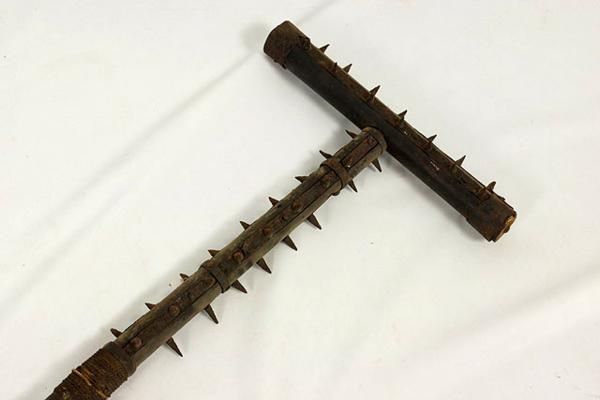
A real antique kumade - this one was more than  260cm long

We looked at the military rake (kumade) last month, so now it’s time to see how it fared after the long centuries of war came to an end. Perhaps it was its utility that doomed it in the field of war – It didn’t have much mystique or status as a weapon, did not seem particularly attached to any social or military group (unlike the masakari or long handled axe, for example, which was long associated with yamabushi), and without anywhere to realise its use as a weapon, people forgot how useful it could be, and little more is seen or heard of it…as such. 
A modern day yamabushi with a masakari (image courtesy of Trip Advisor)


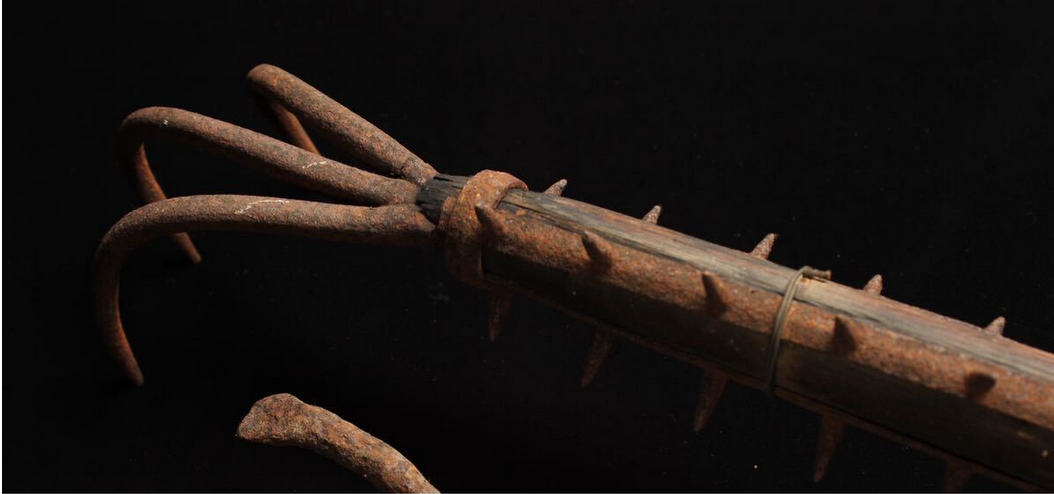
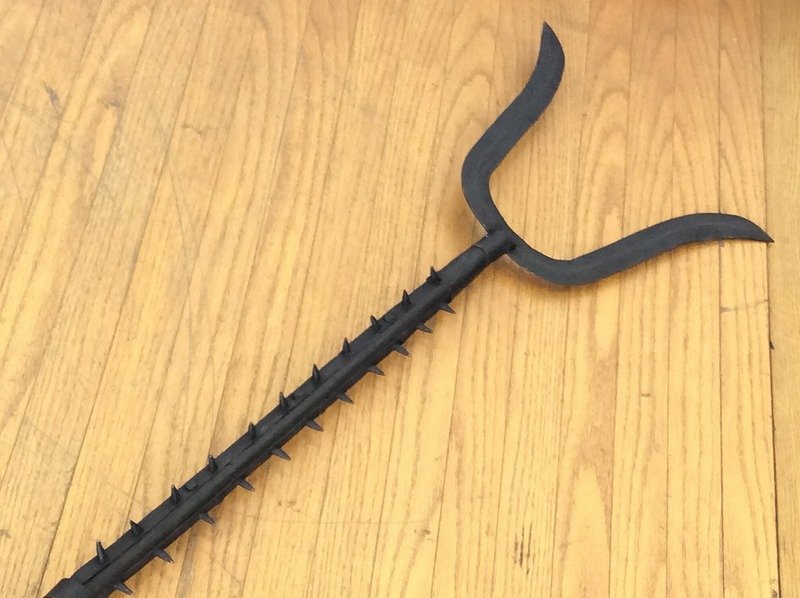
While it doesn’t seem that the kumade made the transition as a weapon into the relatively peaceful Edo period, several weapons were used in civil defense/law enforcement that involved entangling and immobilizing an opponent. These were the triad of sasumata, sodegarami and tsukubo (there are several alternative names, but these are the most common – the fork, the sleeve entangler and the push pole. Matsura Seizan, for example, calls them the sasumata, hineri and shumoku). They were categorized as implements or tools rather than weapons, but their array of short spikes, partly to deter grabbing, would have been capable of causing significant damage, as well as helping to catch and entangle clothing. If you get the chance to see them close up, there is no doubt that you wouldn’t want the business end of any of them near you. 


sasumata

sodegarami


tsukubo


In their use, they could very well have replicated the hooking functions of the rake, and perhaps they were more suitable for use against unarmoured opponents. There doesn’t seem to be much in the way of techniques for these implements that have been passed down, though there are several videos online of people using them in more or less plausible ways. 


I would think that anyone reasonably well-versed in the use of pole arms (and jujutsu, perhaps, given their use for restraint) could come up with similar techniques. 


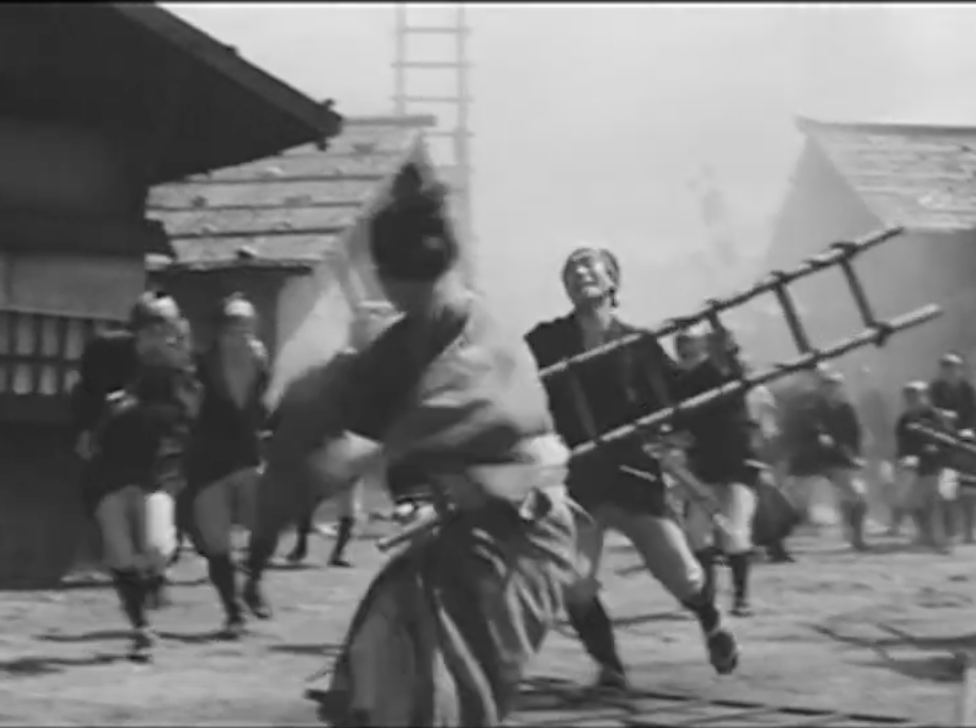
These were not the only tools used to subdue unruly lawbreakers. Anyone who has seen the classic film, Daisatsujin Orochi, starring Ichikawa Raizo, will surely remember the scene where the lone swordsman is confronted by a crowd of constables who attempt to capture him using ropes, doors two-wheeled wooden wagons and ladders (as well was some of the more usual implements just visible in the bottom of the frame below. (This is well worth watching in any case – one of my favourite Japanese movies. it's English title is The Betrayal).


A still from Daisatsujin Orochi - the hero is in the centre - note the the tsukubo and sasumata at the bottom of the frame.

A slightly less conventional law enforcement tool


Though this approach may seem to be a relic of the past, a modern iteration of the sasumata is still a common piece of equipment in schools (and police stations) in Japan (and also in China apparently – I saw one in evidence in a news report about one of the recent mass stabbing incidents) and has occasionally been deployed successfully. It offers the ability to hold off a knife wielding attacker while remaining at a safe distance. Techniques have been designed to give it more flexibility in use, and it looks as if it could, indeed, be quite effective, especially if it is part of a coordinated effort involving several people. An ideal version is depicted in the picture below. 


Teachers training with sasumata

 Here is a link to a video showing training in a supermarket:
https://youtu.be/WtdCxgmqDI4

Note the use of supermarket trolleys, too!


However, as always, the reality of an attack is likely to be quite different from practice. It would require a cool head to use it well against a knife wielding assailant, and, perhaps because of its success in being sold as such a practical response to a knife attack, there has been some criticism of its effectiveness. These criticisms stress the relative ease with which the knife wielder could catch hold of the head, either to twist it around so they can get past, or, by grabbing both prongs, take control of it. (As someone holding the two prongs has a mechanical advantage over someone just holding the shaft, this is quite possible.) The lack of spikes in the centre of the ‘u’ section, a feature in some ‘samurai period’ sasumata also means that there is nothing to stop the aggressor pushing back directly against the force of the defender, possibly forcing the defender to drop the sasumata or risk being cut. 


I like pole weapons but space limitations in Japan means I haven’t had the chance to practice with them as often as I would like. The modern sasumata certainly seems like something it would be fun to play around with.


On a final note, although the sasumata is designed to immobilize an attacker, that is not the only way of using it. The video below shows the owner of a jewelers shop in Tokyo using it successfully as a club in the most basic of ways – and it worked.


https://youtu.be/q1vwgwi-k9Y?si=9_Xv-ugJsCjvXLz9

Thursday, 24 October 2024

The rake’s progress - from the battlefield to modern-day civilian protection - part 1


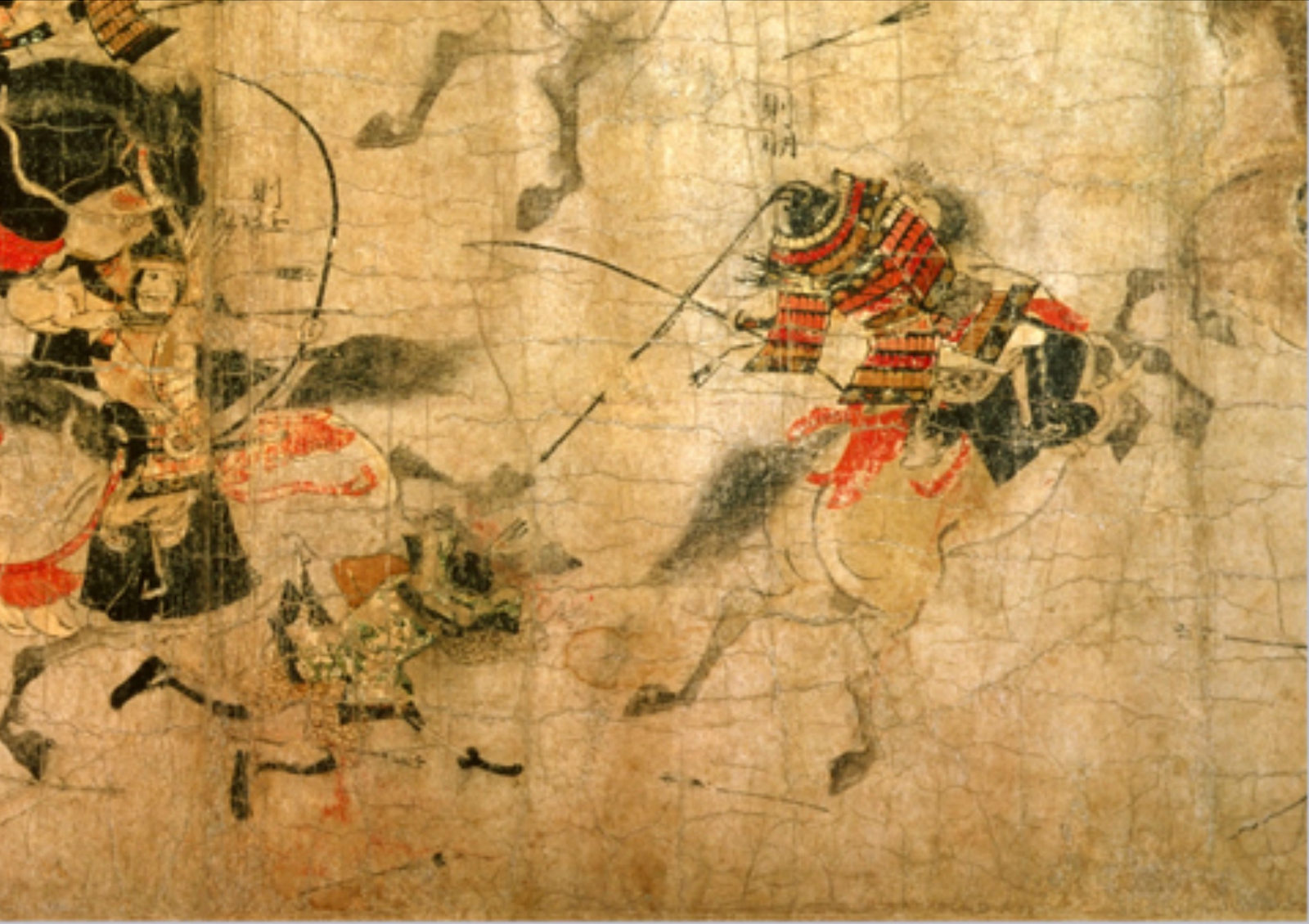
From the Scroll of the Mongol Invasion (Mōko Shūrai Ekotoba) - a fine example of a kumade in the centre.


Today, seeing the leaves beginning to turn to the gold of autumn, I was reminded of that perennial garden chore, raking leaves. It made me think of a reference I came across regarding a certain Matsuda Hidenobu, a warrior of some note who fought at the battle of Sekigahara (1600) during which he is reported to have used a long weapon called a kumade (literally ‘bear’s claw’) to bring down 11 mounted opponents whom his followers then dispatched. What had caught my eye was that the weapon he was depicted with was a large leaf rake (see below).


Chicken or egg? One of these is clearly derived from the other, but they both have poor old Matsuda using a leaf rake.

While it is true that the same word, kumade, is used for a modern leaf rake, this is very far from the weapon that Matsuda Hidenobu must have used.

The word ‘battlefield’ is often bandied about with regard to traditional martial arts – some of them really were created for or used on battlefields; others are more likely to have developed for civilian self-protection in what were very violent times. Some were probably meant as a kind of training to imbue discipline and other virtues in a suitable cultural package. Many are hybrids, adapting and developing military techniques for other purposes. But early examples of the use of the kumade can, indeed, be located on battlefields in early medieval Japan. 


This can be seen in artwork such as the Kasuga Gongen E-Maki (early 14th century - see above) and in the well known Scroll of the Mongol Invasion (13th century), and several instances appear in war chronicles, both on land and at sea. Set at an earlier date than both the aforementioned scrolls, the story of Taira no Yorimori being attacked by one Hachimachi Jiro, who hooked a rake onto his helmet, only for Yorimori to reverse the tables by cutting through the shaft of the kumade with his sword, the famous Nuke-maru, sending Jiro tumbling, and returning to camp with the kumade still attached to his helmet, has a ring of truth to it, despite the clearly fictional basis of many of the individual exploits in these tales.  These tales and picture scrolls were mostly created well after the periods they depict (not in the case of the Mongol Invasion scroll, however), but still in a time of pretty constant warfare, so they can be considered reasonably reliable in the weapons they depict.

Doubling as a weapon and a tool, it is difficult to ascertain the origins of this device, but its similarity to the kind of anchor used by small boats suggests this is a possible source. It is often depicted with a rope or chain wound around the shaft, and although I have seen no depictions (or read any accounts) of how this was used, it suggests the head may not have been too firmly fixed on the shaft and the rope/chain served as an additional means of controlling the opponent if the head became detached (or if the shaft was cut through, as in the story above).


Not surprisingly, it was used differently on land and at sea. On land, it seems to have been used both by foot soldiers and mounted warriors, principally as a means of pulling armoured riders off their mounts – a useful tactic, especially given the amount of cordage and loose fitting pieces that made up Japanese armour. At sea, it could be used not only to grapple with enemy boats, but accounts also note its use in rescuing comrades who had fallen into the water. 

Although it seems to have been effective, it was not particularly common. With the weight concentrated at one end, it is likely it was less well-balanced than more typical spears and naginata. Both Musashibo Benkei, legendary retainer of Minamoto Yoshitsune, who carried it as one of his seven weapons/tools, (which also included a large mallet, a broad-bladed axe and an iron staff, all of which were meant to indicate his strength) and the aforementioned Hachimachi Jiro, were warriors of more than average strength, and it may well be that it was, indeed, heavier and less wieldy than more common weapons. 

A close-up from the Denshoubi showing a hybrid rake-like weapon

That it was used by Matsuda Hidenobu in the battle of Sekigahara, suggests it continued to be used throughout the Sengoku period, and perhaps beyond. The fact that surprisingly few examples have survived to the present day suggests it quickly fell out of favour, perhaps to be replaced by other weapons more suitable to the demands of new era. A screen painted around 1614 (the Denshoubi probably by Iwasa Matabei) depicting scenes in Kyoto, shows what looks like a kumade, together with other pole arms, on display at a theatre. Here, however, it seems to have assumed something of a civic role, as something symbolic or to be used in a crowd control function. I believe that it is in this guise that it continued up the the modern era - more of that next time.

One last picture of Matsuda Hidenobu with his leaf rake.It looks like it is from one of the Osprey publications, but it shows the difficulty of finding accurate source material.