Showing posts with label sumi-e. Show all posts

Sunday, 31 December 2023

Musashi’s Dragon Painting

Close up of the cover of the book on Musashi's ink painting (I've only ever seen one).


Another year draws to a close and the Year of the Dragon begins here in Japan (yes – it is a somewhat odd combination of the Chinese lunar New Year that begins a couple of months later, and the western New Year).


The imperial connections of the dragon in China are well-known; in Japan there was a strong connection with esoteric arts and Zen Buddhism in particular (at least in art) where they are seen as protectors of the Buddhist law. In this respect, they are still to be seen on the ceilings of many temples in Kyoto – some of them dating back to the late Muromachi  period (late 1500s). Some of these are on public display, some in areas only open to the public during the special openings in the spring and autumn, and some are rarely to be seen at all - perhaps only when peering through the wooden slats into the gloom. Some of these are very evocative, some less so, but they certainly have a power in situation that is difficult to reproduce in photographs.


Ceiling by Kano Tanyu at Daitokuji, Kyoto


The same may be said for the many dragons depicted on sliding doors and screens, some of them very powerful, others quite strange (or even both in the case of some of Kaiho Yusho’s paintings, where the dragons loom out of the darkness as presences quite different from the scaled creatures of Chinese lore. I wrote about some of the great dragon paintings (Master Dragon Painters), and strongly recommend seeing them in the flesh if possible. The reality of a painting is more than the image itself - the setting, the lighting, the size, the texture, the sense of antiquity, - all these add something to the experience that make it more than visual alone. With ink, the age of the paper, the way the ink has sunk in, faded or worn off – the patina of age, I suppose you could say – is part of the work. 


Kaiho Yusho on display at Kennin-ji, Kyoto


Kaiho Yusho's dragon from Kitano Tenmangu Shrine, Kyoto (close-up)


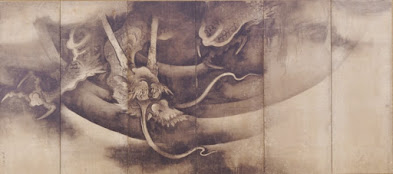
For whatever reason, I have always found the works of Miyamoto Musashi particularly powerful in the flesh (not something I’ve had the chance of doing very often, mind you), but I have not had the chance to see his dragon painting. Of course, he is better known for the more modest creatures he depicted, things he had seen with his own eyes, but at least one dragon painting survives (and there is supposed to be another, even more elusive one, too). 


It's not a good reproduction, but I hope you get the idea.


This painting is little known; it is scarcely visible on the internet, even on Japanese sites, but it exemplifies his art in several ways and is well worth closer examination. 


Like many of his paintings, it combines strong brushwork with a sensitivity to tone and depth. The brushwork is dynamic, using layered light and dark ink in increasingly powerful strokes to delineate the dragon’s head and claws. There is a dryness, almost asperity, in the use of dark ink in the claws, the teeth, and the barbels (whiskers) that extend whiplike into the empty space on the left of the composition. These echo the sharp curves of the waves and the dragon’s neck as it emerges from the blurred depths of the clouds. 


The dragon faces left into space, but his eyes look elsewhere. The look on his face is mild, even sheepish, recalling some of Kaiho Yusho’s dragons. (It is quite likely that Musashi had seen and perhaps made copies of Yusho’s work). What is he looking at? 


As I’ve written before, there is recognition now in art circles that the pairing of dragon and tiger had strong associations with military divination, and these connotations would have been familiar to many warriors. It is possible that this painting was one of a pair – I have seen it suggested there could have been a tiger, or as in the case of Kaiho Yusho’s works, another dragon. Perhaps the eyes are a clue. 


If this was painted as a stand-alone piece, Musashi was a knowing enough artist to be aware of the tension that a single element of a pair would create. Japanese (and Chinese) art emphasized the interplay between elements in a variety of ways. These might be purely visual, or they might be symbolic. The balance could be achieved in a single work, or in a pair, such as the tiger and dragon, or in the sliding doors on all four sides of a room. Sometimes, it would be in the mind of the alert viewer, where a clue might furnish the missing element, or the mere absence might give cause for consideration of what was not there.


Rhythm and the interplay of kyo and jitsu (empty and full - a kind of yin and yang pairing that was used in a variety of technical explanations) were key features of martial arts, so it should come as no surprise that Musashi would be particularly alert to such possibilities in his art. 


In this work, perhaps, the dragon is a symbol of the wisdom of both the natural and higher realms and it is the viewer who is approaching as a student hoping to gain the treasure of understanding. Here we are putting ourselves in the place of Musashi, who had spent his life on such a quest. And perhaps, in the guise of a dragon, Musashi is looking back at us.


You may also be interested in the following two posts from last time the year of the Dragon rolled around.


The Master Dragon Painters


A Deeper Reading of Musashi's painting


Also, for more on the connection between paintings and military divination: Tiger Paintings - a martial dimension 


Wednesday, 16 February 2022

Tiger Paintings - a martial dimension


Maruyama Okyo (1733-1795)


If you were to make a list of typical ‘oriental’ motifs associated with the martial arts, tigers might come somewhere near the top. Not surprisingly, given their strength and ferocity, they have an obvious appeal to those involved in fighting arts. In China, they have provided inspiration for whole systems, as well as components and techniques in many others. 


While tigers are native to China, that is not the case with Japan, so there the attitudes and lore concerning these animals is primarily Chinese in origin. In art, as I mentioned in my previous post, early examples of tiger paintings from the continental mainland became models that Japanese artists were to copy for centuries.


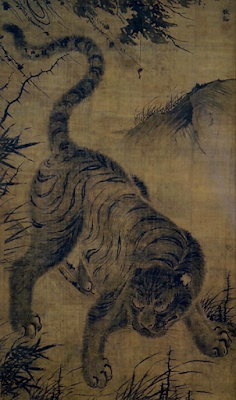
Chinese C13th - possibly by Muqi
(from the collection of the
Tokugawa Museum, Nagoya)


Traditional Chinese painting (and thus Japanese, too) can be seen as taking a different approach from western art (or at least western art from the renaissance onwards). The cultural concerns of these two streams of art dictated different interests : although both were concerned with depicting reality at a deeper than simply surface level, they differed on what this reality was, their art emphasising themes that had the greatest resonance in each respective culture. 


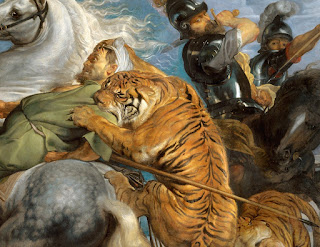
In the west, stylistic developments were connected with increasingly close observation of subjects, combined with an interest in science, particularly optics, but also mathematics, harmonic scales, and anatomy. Developments in these areas can be seen in paintings from the Renaissance onwards. Artists developed an interest in depicting forms ‘in the round’, and utilising their knowledge of perspective, anatomical accuracy, proportion and harmony in composition, as well as the use of camera obscura and other optical aids. Chinese and Japanese artists were also interested in the natural world, but they were less interested in exact physical appearances rather than the spirit of their subjects, including such qualities as strength, softness, and flexibility. This, in turn, required the artist summoning up something of that quality in himself and imparting that during the execution of the work.


Rubens' Tiger Hunt (1616-17). The painter's concern
with the accurate physical representation of the tiger
is clear.


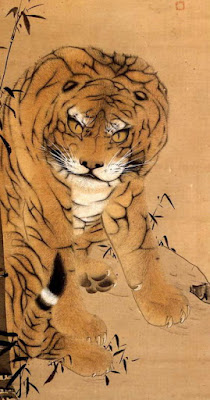
Knowing this suggests there may be more to Japanese depictions of tigers than meets the eye. At different periods, different styles are evident, but until relatively modern times, realism was not a primary concern. Certain features are repeated: the glaring eyes; the prominent eyebrows, the rhythmic line of the body, heavy paws, bristling whiskers and sinuous tail, and the stripes that both describe and break up the curves of the body. Rather than depicting a body of flesh and bone, many paintings seem to show a ripple of supple energy in a striped coat. 


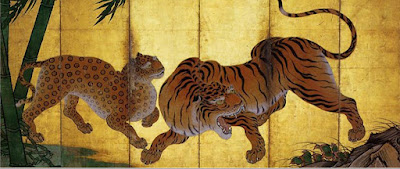
Kano Sanraku (1559-1635) A contemporary
of Rubens, but with different artistic concerns.


Kano Michinobu (1730-1790)
In this later work from the Kano school,
the spirit of the tiger seems quite different.


This may very well be a personal interpretation, and it might be misleading to see Japanese painters as having particular insight into the kinds of energies of interest to bugeisha without any further evidence. Tigers had a range of widely accepted symbolic meanings, some of which were certainly applied to the manners and attitudes of classical bushi. These included the ideas of preparedness (a tiger always sharpens his claws) and virtue (tigers keep their claws sheathed and hide themselves away in bamboo thickets, not outwardly displaying their prowess or threatening others), as well as power and ferocity, and it is highly likely that both the painters and their audience would have had no problem seeing the paintings as illustrative of these. (I discussed an example of this kind of symbolism here).

From Nijo Castle - a sharp-clawed tiger


There is another area where the symbolism would have been recognisable to members of the warrior class, especially the higher ranking members, and this is the realm of military strategy; in particular, military divination.


Military divination is an area that has seen little research among modern historians, tainted as it is with the whiff of superstition. Nonetheless, it was given serious consideration by those involved in warfare. The link with art comes through research into the work of the 16thcentury monk-painter Sesson Shukei (ca.1492-1577), and has only recently come to light.


Sesson was unusual as a painter; although he was highly accomplished, he did not work in nor had he ever visited the capital, Kyoto, but was based to the east, largely in the Kanto region around Odawara, another burgeoning cultural centre. Sesson travelled a fair bit, not that unusual for monks, from his birthplace in present-day Fukushima down to the Kamakura and Odawara area, and built up connections to several networks of learning, notably his Zen lineage and also the Ashikaga Academy, a center for studying Confucianism, medicine, strategy and I-ching divination, whose graduates often found employment from warlords as advisors, negotiators and diviners, skills that were much in demand in those unsettled times. Not all the roles were military – Confucianism was seen as an important tool of governance and experts who were well versed in these teachings were valuable – but military divination was also one of the valued skill sets.


Sesson’s travels took him close to the academy, and several of his works are based on themes closely aligned to its Confucian teachings. It would not have been surprising if he attended lectures there. His mentor and possibly dharma master, Keijo Shisui, had known connections with the academy, while the head of the academy, Kyuka, served Hojo Ujiyasu, the powerful lord of Odawara (and rival of Takeda Shingen and Uesugi Kenshin) and it was for Ujiyasu that Sesson painted his screen painting, Dragon and Tiger, (now in the Cleveland Museum of Art. There is another by him or his studio in the Nezu Museum, Tokyo). 


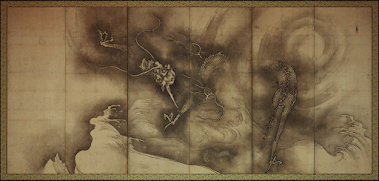
Sesson's Dragon (painted between 1546 -1556) -
perhaps the most human of dragons I have seen.
Note the powerful forces that swirl around the dragon,
obscuring and revealing its form. (click on the picture to see
a larger version)


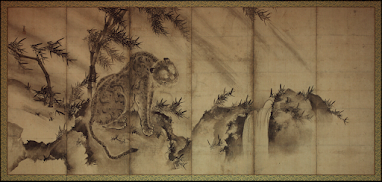
Sesson's Tiger may look playful (Sesson's distance from
the cultural centre, Kyoto, meant he 
did not have access to the more famous models
of dragon and tiger painting), but it crouches,
waiting patiently for the opportune moment,
resisting the strong winds all the while.


For an artist interested in philosophical concepts of being and nothingness and the mutability of form and phenomena, sumi-e is a particularly apt medium. It is hard not to imagine such an artist embuing his works with aspects of his learning in these areas. The art historian Yukio Lippit sees Sesson’s Dragon and Tiger as an explicit representation of this knowledge – in particular, they show the interplay of yin and yang as represented by the tiger and the dragon. For a student of the I-ching, the world is in a state of dynamic flux, constantly generating and regenerating. The dragon, Lippit explains, illustrates the spacial element: visibility and invisibility – “states of exposure and hiddenness”, calling to mind the constantly changing dynamic of advantage and strategic opportunity. The tiger shows the temporal element: waiting, reading the situation, knowing how to choose action or inaction. For men such as Ujiyasu, all this would have been readily understandable. Lippit goes on to suggest a similar connection in Kaiho Yusho’s dragon paintings, as well as other dragon and tiger screens of the Muromachi and early Tokugawa periods.


Kaiho Yusho (1533-1615). One of a pair of dragon paintings
from Kitano Tenmangu Shrine, Kyoto. Looming from
the mists, it suggests the interplay of the visible
and the hidden. Kaiho Yusho was from a warrior family
and maintained contacts among the powerful members of that class. 


All of this is fascinating to me, as I had always felt (or imagined?) these works to embody some kind of deeper understanding related to the mix of spiritual and martial teachings that were connected to the traditional bugei. As yet, there has been little work on this area – Lippit’s own work is very recent – but I look forward to discovering more. I recommend this lecture by Lippit from early 2021 for those who want to know more. (The observations on military divination that I summarised above begin around the 30 minute mark).

https://www.youtube.com/watch?v=voIECq_k1xE).


Tuesday, 16 November 2021

The Wagtails Sing - when nature meets a sword school


Seen in a shop window - Wagtail on a Lotus Leaf
attributed to Sesshu


The traditional Japanese calendar was a complicated thing. In addition to the 12 months, auspicious and inauspicious days (still consulted, especially for weddings) there were also 24 months or mini seasons and also 72 micro seasons. I don’t know how widespread the observance of these micro seasons was – I imagine more so in literary circles…or perhaps only there, and knowledge of them is certainly not part of everyday life nowadays, but occasionally something happens to remind you of them.

Passing by an antique shop last month, I caught sight of an unusual painting – a work in ink depicting a wagtail on a dead lotus leaf. There is something about good sumi-e that draws you in, a living quality in the surface of the paper, the subtleties of the ink, the effect of age and decay as well. And it was clear that this was an old piece from the color and quality of the paper. The signature declared it to be by Sesshu, the doyen of Japanese painters, regarded as both the root and the highest exemplar of the style – I could not say if it was genuine, but it certainly looked to be at least 400 years old to my eyes.

Sesshu's signature...it must be genuine!!?


The age itself gives a work a certain frisson, and the subject was of interest, too, wagtails being an almost daily sight on the edges of the city. While not common (I don’t remember having seen an example before) the theme is not without precedent. In particular, there is a work by Muqi (J. Mokkei) of this subject, which I suspect became the model for this motif. Of course, unlike several other works of his that served as models for themes in Japanese paintings (his dragon and tiger, long-armed monkey (gibbon)), artists could see the subject for themselves and, perhaps, felt no need to copy his composition.

Muqi's verson of the wagtail on 
a withered lotus leaf (Courtesy of
the MOA, Tokyo)


The wagtail and the dead lotus are both symbols of the turn of the seasons as summer gives way to the early days of autumn, but the display of the painting was more deliberate than that. Sekirei Naku (wagtails call) is the name of one of the micro seasons (September 13-17), and wouldn't you know it, that was exactly the time the painting was on display. Those more attuned to the lore of Japanese poetics would, no doubt, have realised this straight away.

The wagtail itself is a common bird throughout Japan – certainly in Kansai. Their distinctive movement not only earned them their name in English, but lent its name to a sword technique that is particularly associated with the Hokushin Ittō-ryū and from there it came into kendo. There it seems to have become a descriptive term for an up-and-down movement of the tip of the sword (kissaki), with no clear consensus on the precise usage. However, it is still preserved in the Hokushin Ittō-ryū.

Sekirei no ken, as the technique is known, relies on the sensitivity of the kissaki and the ability to threaten an attack that cannot be accurately predicted. This may involve subtle movement of the tip of the sword, directing the i of the wielder, thus giving it its name. In kendo, this has become an up and down motion with the general aim of confusing the opponent.

The Hokushin Ittō-ryū is not the only school to make use of this kind of movement of the kissaki - an up-and-down movement was also used by the Kage-ryū, for example. In fact, it would probably be safe to say that every well-developed school of swordsmanship had teachings on the use of the tip of the sword, and there are probably more similarities than differences between the different schools. But the Hokushin Ittō-ryū is the only traditional school I know that uses the imagery of the wagtail for their technique. 

(Written on the last day of 'The ground starts to freeze').


This is the mokuroku (transmission document)
 awarded to Sakamoto Ryoma, a famous practitioner
of the Hokushin Ittō-ryū


Thursday, 31 December 2020

Happy 2021 - Year of the Ox


Fast Bull - a beautifully painted work by an unknown
painter from the Kamakura period - originally a hand scroll, 10 Fast Bulls,
it was remounted as a hanging scroll (courtesy of Tokyo National Museum).


Cattle do not seem to occupy a great place in samurai lore. Though they were not uncommon in Japan, they seemed to have been used either as agricultural beasts of burden, or for pulling the carriages of nobles – neither occupation seeming to appeal particularly to the warrior class.


They appear in art in both these roles, as well as part of the 12 animals of the zodiac, and in Zen art as well. Perhaps they are best known in this connection in the 10 ox herding pictures, which provide an analogy to the path to enlightenment. These were formulated from earlier versions by Guo-an Shi-yuan (Kakuan Shien) in the 12thcentury, and illustrated most memorably by the 15thcentury priest-painter, Shubun. The pictures lose some of their charm when they are reproduced – the originals are small – intimate in their scale and detail, but I don’t think they have been equalled by later artists who tackled the subject.


No. 6 in Shubun's series of Ox herding pictures


As I mentioned in my New Year post last year, the bull also appears in Musashi’s writing – Rat’s head, bull’s neck is an entry in Gorin no Sho to describe a sudden switch in approach. I mentioned some commentary on the possibility of the original being horse, rather than bull (the two characters are very close) but given their places in the progression of the 12 animals, I think the combination of rat and bull was well known, and would thus have made sense to Musashi. The story of the order of animals also suggests some sense of a sudden change: the bull agreed to give the rat a ride to the place where the 12 animals were to meet; as they arrived, the rat jumped off the bull and so became the first to arrive.


Musashi also depicted a bull in a relatively unknown painting of Hotei. Here, he is riding on the back of one. This may have been a nod to the 10 oxherding pictures, and given Musashi’s connections, it is quite possible that he had seen Shubun’s works. Whatever its inspiration, it displays brushwork typical of Musashi, and establishes a dynamic rhythm in terms of contrast of line and volume and light and dark. Like many of Musashi's paintings, the tone seems lighthearted - they seem to be enjoying life. In Buddhist iconography, where Buddhas are depicted riding on animals, these may be interpreted as control of the physical passions. In this case, Hotei and the bull appear to have different ideas on where to go next, so perhaps his control was not as complete as he thought.


Below: Musashi's painting of Hotei Riding a Bull - this is from the book "Miyamoto Musashi no Suibokuga" (Miyamoto Musashi's ink paintings). Relatively unknown, I couldn't find any reproductions online. 


Lastly, despite my initial comment, the bushi did not totally disregard the nature of the bull – the famous daimyo Kuroda Nagamasa famously had at least two helmets made with sweeping water buffalo horns as decoration. Later generations of his family had similar helmets made, as well. This was in marked contrast to the upturned bowl design of his father, Kuroda Kanbei, who was known for his brilliance as a strategist. Although he fought successfully in several campaigns, Nagamasa lacked his father’s brilliance and may have felt that the image of a bull, powerful and straight-forward, expressed his personality better.

A Happy New year to all my readers - let's hope it's a good one!

Two of Kuroda Nagamasa's helmets - another one of his famous helmets was shaped in an abstraction of the cliff at Ichinotani, where Minamoto Yoshitsune led a charge down steep cliffs to carry the day. Perhaps Nagamasa was emphasising that he, too, was a man of action. (Click on the picture to see both helmets).


Tuesday, 19 May 2020

Miyamoto Musashi's squirrel – samurai wordplay

Musashi's Squirrel and Grapes (cut off slightly on the right)


The bushi were a cultured lot – some of them, anyway – and Japan was a cultured society. Nowadays, when we look at the art of great civilisations, we tend to value it for its beauty – indeed, that is one of the things that attracts us to art in many of its forms. However, there is a lot more to art than that (as a cursory glance at any display of contemporary art will tell us) – and there always was. 

As a form of communication, art has messages and meanings beyond the aesthetic. Its value as a didactic and political tool was well understood by the rich and powerful of feudal Japan. Decorative schemes in castles, temples and residences contained subtle and not so subtle messages that their audiences were practiced in reading. They were messages about power, morals, aspiration – the usual things. The artists might also include details pointing to their lineage, linking to well-known works, thus emphasising the connection with more famous predecessors. (This was happening in the Kano school, where the sidelined Kyoto branch thought it necessary to point out that they were just as much, if not more, worthy successors to the Kano tradition than the politically favoured blood descendants of the founder who ran the Edo branch – their paintings were also beautiful, as you can see here). Other works of art operated on a smaller scale, with more personal messages for the satisfaction of the careful viewer.

Which brings us on to an often overlooked painting byMiyamoto Musashi: Squirrel and Grapes

As a subject, it was an auspicious one, symbolising abundance and fertility: grapes are obvious images of plently, while squirrels were seen as being like mice which were known for having large numbers of offspring. Perhaps not an obvious choice for Musashi, although it could be argued that it reflects a feeling of personal well-being and satisfaction with his position in the world. Indeed, at this stage, relatively late in his life, he was a guest of the powerful and cultured Hosokawa family in Kumamoto, far from the reverses he may have suffered in trying to establish himself in the capital. However, there is more to it than that.

A typical depiction of the squirrel and grapes theme on sword mountings


The title was also understood as a play on words: the word for grapes (budo) is a homophone for budo(martial ways), while squirrel (risu) is similar to rissuru, which means something like to dedicate or discipline oneself. Thus the picture is a pun that refers to discipline in the martial arts. It is in this connection that the motif was utilised by bushi as decoration in sword mountings and the like.  


Musashi’s treatment of the theme is distinctive. Like his more well-known paintings of birds, this one emphasises poise – the squirrel balances on the vine, its eyes sharp, and the tail sweeping up as it prepares to hop onto the next branch or reach out for the grapes below. This sense of dynamism is portrayed through the broad curves of the tail and the body, with the more precise details of the face and claws suggesting the focus and contained energy of a body about to burst into motion.  

Musashi’s work is notable for his sparing yet powerful use of dark ink to focus and control the composition, keeping the dynamism of the subject through rough but fluent brushwork. It was a style that stemmed from Muqi and Liang Kai, both 13thcentury Chinese monk painters whose works were more admired in Japan than in their native China. Musashi’s artistic education is a matter for speculation, but his style and subject matter suggest he had seen some of these works as well as those of his older contemporaries, Kaiho Yusho and Hasegawa Tohaku, who were both influenced by these artists. Kaiho Yusho and Hasegawa Tohaku were based in Kyoto for much of their careers, and famous works by the two aforementioned Chinese painters were also held in temples in that city. 
 
The 6th Patriarch Chopping Wood by Liang Kai
This work is now in the Tokyo National Museum, but it is quite possible
Musashi had access to it at some time. (Lang Kai's paintings suffer greatly from
reproduction - you cannot really appreciate the subtlety in reproductions).

Crows by Kaiho Yusho. Yo can still get some idea of the power of this piece even though the reproduction is less than perfect.


Of course, early in his career Musashi spent some time in Kyoto, but what his position was is far from certain. At some time he completed some fine paintings for Toji Temple, which maintains he lived there for a period of three years or so after his duels with the Yoshioka swordsmen, and also suggests that he studied with Kaiho Yusho during this time, but this is far from certain. (The priest Takuan, who was linked to Musashi in the famous novel by Yoshikawa Eiji, was head of a sub-temple at the Daitoku-ji complex where Tohaku saw a triptych by Muqi that had a major influence on his style. Although there seems to be no firm evidence to back it up, the temple also claims a connection with Musashi – perhaps that is where Yoshikawa got the idea about Takuan being Musashi’s mentor.)

Wherever he developed his skill with the brush, it is difficult not to see in his works touches of his own experience, and to think that they express something of what was important to him in life.

Musashi often chose animals and birds for his subjects, and among those, it was the small and everyday varieties that he focused on. That he would choose these as subjects, in some cases strongly suggesting connections with aspects of his heiho– his martial art – rather than the powerful, regal creatures that we might normally associate with the arts of war, certainly says something about the man.

A close-up showing the squirrel and one of the well-nibbled bunches of grapes.


Can we read anything else into this inquisitive squirrel? I think we can. If we look carefully, we can see the grapes are mostly gone. Is it late in the season or has another squirrel been here already? Whatever the reason, this one seems unphased – it continues, as full of enthusiasm as ever. Is this the message then – the importance of continued discipline, even though many of the obvious rewards have gone? It would be in keeping with Musashi’s writings. But more than that, given the way the painting pulses with life, it suggests there is an enthusiasm, almost a joy in this. I would like to think that this, too, was part of his message.

Friday, 28 June 2019

Victor Harris - the original Book of Five Rings


Perhaps the best cover of any version of Gorin no Sho - and the picture is one of Kuniyoshi's depictions of Musashi.


Published by Overlook Press in 1974, this was the first translation of Musashi’s work into English, and for a long time, the only one. One might occasionally pick up fragments in other works – I am particularly reminded of one story in an illustrated book on samurai in my secondary school library, a story about a fan-wielding master of saiminjutsu who managed to persuade Musashi that he was carrying a sword). It has been around for so long, certainly in my life, that it has become part of the landscape. The phrases it used, even the title itself – A Book of Five Rings (Scrolls of the Five Elements would be more accurate, but it doesn’t have quite the same ring) have become familiar. Other translators may have chosen to alter some of these classic formulations, sometimes for better, sometimes for worse, but the shadow of the original continues to hang over them. It is not easy to assess. But this is escaping the issue. Does it deserve respect for more than its merits as a forerunner in this genre?


First, it should be noted how well it has stood up in the forty-five years since it was first published. Victor Harris (who died in 2017) was an experienced kendoka, an expert on the Japanese sword (President of the Token Society of Great Britain), and head of the Japanese Department of the British Museum. He was deeply involved in this field. For all that, A Book of Five Rings was a relatively early work. Would he have liked to change anything? I have no idea, but I have read that he would sometimes refer to Musashi in his teaching, so I am sure his understanding and appreciation of the work deepened and matured over the many years since he first worked on the translation.


Despite the fact that I no longer use it as my translation of choice, it is still a good choice for anyone interested in Musashi’s writing, although its strengths as a book (at least in the original version) perhaps weigh stronger than the absolute qualities of the translation. Compared to all the subsequent works, it is better set out as a book – the care given to the layout and spacing of the text makes it exceptionally easy to read and consult; the front matter, although not extensive, is relevant (especially for those days when very few in the west had heard of Musashi). It is clear and well-written, and despite being somewhat dated (Musashi ‘scholarship’ has come on a lot since those days) provides a good overview of the standard view of Musashi’s life and significant duels. There is a slip in the general historical background when he confuses his shogunates, but this is a minor detail (and shouldn’t be used to judge what is a serious and well-considered work.) It has atmosphere, and this is something that is often overlooked – it shouldn’t be. There is also a good choice of art and photographic references – most of the subsequent translations have followed his lead on this – including some difficult-to-find pictures which are rarely seen elsewhere.


There are weaknesses, but these are not fatal flaws. Chief among these is the writing style, which has a tendency to be somewhat opaque. I do not necessarily feel that translations should read as if the writers were our contemporaries – given Musashi’s background and class, (and style in the original) there is a degree of terseness that is not easy to preserve in English, but in this work, the meaning is not always as clear as it might be. I feel that there is a lack of authority, perhaps because of the author’s lack of grounding in the technique (although he was a serious kendo practitioner and was later involved in older styles of Japanese sword arts, kendo and kenjutsu are different animals), as if he didn’t quite understand the finer points of the techniques he was writing about. I hesitate to say it, especially in view of his continued involvement in the field and obvious facility with the language, but it looks to me as if he was unsure of what it was Musashi was saying in some places. This is natural enough, especially in descriptions of sword technique, but translation is also an act of imaginative creation: as a writer, the translator attempts to reimagine the meaning of the words and translate their message with reference to the wording and style of the original as necessary. I feel as if Harris sometimes gives more weight to the words than to the meaning, with the result that something that is quite clear in the Japanese is suddenly open to a range of interpretations in English. But this is the translator’s art – any translation may be more or less successful at this. Some of his successors have made more informed decisions, better decisions I feel – but they also had something to work with, as Harris did not.


Yes, it still stands on its own merits. For anyone serious about looking into Gorin no Sho, I would recommend other versions as well, or perhaps primarily, and if your Japanese is up to it, versions in Japanese, preferably in both the modern and original Japanese. The language Musashi uses is not generally difficult (although a few sections might prove problematic) and the Japanese certainly gives a more visceral feel to the work. But if this is a step too far at the moment, you won’t go far wrong with the Victor Harris translation – a book to inform and inspire.