Friday, 3 February 2023

The Nanten Staff - Take that!


One of the distinctive sights of winter in Japan, and particularly in Kyoto, are the bright red berries of the nanten bush (Nandina). They are often planted just by the front door of houses and are used in the New Year decorations known as kadomatsu that can be seen outside businesses, department stores and some larger residences during the New Year period and sometimes as much as a couple of weeks after that.


My first encounter with nanten gave me a rather different impression - I had come across it years before I came to Japan in the book Zen and the Art of Calligraphy by Omori Sogen and Terayama Tanchu, now out of print but worth getting hold of if you’re interested in that kind of thing, in the form of the staff wielded by the Zen teacher who took his name from it – Nakahara Nantenbo (1839-1925). It's hard to believe, but information about that kind of thing was hard to get hold of in those days. The mental image of a fierce Zen practitioner and his nanten staff stayed with me, but it was only quite recently that I came across a picture of him and what might be his staff. I had imagined it would be something like the one in the picture below, but in fact that might not be the case.


An earlyish picture of the famous priest
with quite a fearsome looking staff.


He was known for his unstinting efforts to preserve and revitalize the Rinzai Zen tradition but is perhaps better known in the west for his calligraphy and Zen paintings. Like Yamaoka Tesshu, the swordsman, calligrapher and statesman, he produced huge numbers of works, although unlike Tesshu, he professed no skill in the art. He was similar to Tesshu, too, in the ferocity which he brought to his practice, regularly engaging in Dharma combat with other priests reportedly chasing the losers out of their temples. He and Tesshu had something of a rivalry, and though Tesshu may have practised under him, they were also reported to have taken part in Dharma battles with each other, with neither giving an inch.


A picture by Tesshu of Nantenbo teaching his
charges.
(From Stevens' The Sword of No Sword')

As Tesshu's picture (and Deishu's verse) suggest, Nantenbo was also famous for his liberal use of his staff as a part of his teaching and it was this staff, cut from a 200 year old nanten bush he came across in his travels, that earned him his sobriquet. It was also the subject of his most distinctive paintings. The photograph below may show the staff. 


An older looking Nantenbo, but is that
his staff?

Perhaps, staff is a misnomer. I have seen it described as a shippei, which is a priest's stick that looks something like a riding crop. In any case, the one in the photograph has similarities to this depiction:
In this painting of his staff, the resemblance to the photograph is clear


However, his paintings are often titled ‘shakujo’ (although it is unlikely he gave them titles himself), which is a priest’s walking staff. The photograph near the top of the page looks more like a walking staff, and you would certainly remember if you'd been hit with it. Later in his career, he retired his famous staff, apparently giving it into the keeping of Empuku-ji, where it probably remains to this day…or so I thought, before finding a reference to it in a couple of catalogues from the late eighties from the museum of Zuigan-ji, where Nantenbo was, at one time, abbot. This is also the temple that was founded by the famous warrior Date Masamune, (see here for more information), and from which Nantenbo retired his abbotship after the famous statue of the warlord was damaged by an acolyte. It was also after this incident and a subsequent period of self-reflection that he retired his nanten stick from service, so the connection with Zuigan-ji seems more likely. It does suggest a problem with the photograph – he apparently retired the staff around 1893, when he was in his early fifties, but he looks much older in the lower picture. Perhaps that is not his nanten staff after all.


Another version  – this one uses the more usual vertical format. These paintings were typically accompanied by an
inscription saying something like  "If you speak or if you don't, you get 30 blows of my staff in any case."

Coming from a samurai family and having a strong, somewhat unruly nature, it might not be surprising that he kept company with martial artists and members of the military (including the famous generals Nogi Maresuke and Kodama Gentaro, both of whom were students of his). One of his notable students, Deiryu, was introduced by his brother’s kendo teacher, and in the early 1870s, Nantenbo was actually in command of a local militia (albeit one consisting of clergy, doctors and Confucian scholars), apparently training them in the use of the sword, spear and bow. Although not overly tall, he was powerfully built and also unusually strong. It was reported that he had travelled through the country during the 2nd Choshu Expedition (1865) and had shown he could take care of himself on several occasions.


He also had at least one ardent kendo practitioners amongst his students. A certain Yoshida Masahiro related the story of studying under him to improve his kendo. After a few months during which he made no headway with his study, Nantenbo told him he should give up kendo (meaning that he would get nowhere if he couldn’t figure this out). Nantenbo had apparently set him a kind of koan by striking a small bell and (presumeably, although the account I read was not clear, asking him something like "Does the sound come from the strike or the bell?). Yoshida spent a further 3 years before he had a sudden realisation while getting on a bus, that there was no separation between the strike and the sound, and thus in kendo there was no separation between the striker and his opponent. For Yoshida, those 3 years were very tough, but he makes no mention of the methods that Nantenbo used, except that he struck the bell 6 times. It must be noted that for a kendo student, especially in those days, being struck in training would not have been anything to note. This may have been in Nantenbo's later, 'gentler' days.


So much for Nantenbo's staff. I would like to track down a picture of it – if I'm successful, I will post it here.    


Saturday, 31 December 2022

Happy New Year 2023 – Year of the Hare (or rabbit, if you prefer)


Edo period netsuke: Hare with Loquats © The Trustees of the British Museum

For those used to the Chinese Lunar New Year (which begins some time in late January or early February), it might seem strange that I habitually start the year with the animal of the coming year. In Japan, the Gregorian calendar was adopted at the end of 1872, with the 3rd day of the old 12th month becoming the 1st of January. Certain aspects of the old calendar were kept, and this included the system of assigning animals to each year. Thus, now each animal year begins on January 1st. (The old calendar system is interesting in its own right, and I will return to it briefly a bit later in this post).


It is, in any case, a chance to look at some examples of how animals were depicted in Japanese art. The Japanese themselves, if we allow such a generalisation, have preserved and curated their culture, presenting a broad narrative of themselves and their society that contrasts them to both their Asian neighbours and to the West. While this has inevitably smoothed off the rough edges, it has also been highly successful in preserving certain unique aspects of the culture. One of the largely unquestioned tenets of this view is that the Japanese are deeply respectful or appreciative of nature. While it would be easy to point out examples to contradict this, there is no denying the importance of the natural world in visual art. For hundreds of years, plants and animals have been seen as proper subjects for art, and feature repeatedly on any number of artifacts made for all ranks of society.

Rabbits Frolicking in the Waves (Kano Osanobu 1796-1846)


2023 is the Year of the Rabbit, or, perhaps more accurately, hare – the Japanese word usagi can refer to either. The hare appears early in Japanese mythology. The Kojiki, a collection of ancient tales and mythology, written down in the early 8th century, features a story with the white hare of Inaba. The motif of a white hare (or rabbit) in the waves found in Japanese art derives from this story – although is likely that the character that can be read as ‘white’ should more properly be read as ‘naked’, but white certainly makes for prettier pictures.


Hares have long been associated with the moon, and the symbol of the hare in the moon (the yang in yin) is counterbalanced by the three-legged crow in the sun (the yin in yang) in some schools of esoteric Daoism. In Japan, esoteric schools involving the sun and moon certainly existed, but I have not read of any strong esoteric connections with hares.


It also appeared as a motif in the armour and accoutrements of the bushi. Although the Edo period, when war was no longer a likelihood, saw a range of decorative helmets being produced, many individual and unusual designs were also produced during the 16th century, when war was still a regular state of affairs. 

Helmet of the powerful warlord Uesugi Kenshin (from the site 戦国カフェ)


This is another helmet from the same period.


Note that that both of these examples include a crescent moon, preserving this ancient connection. There are a number of such helmets surviving, suggesting this was felt to be a suitable image for warriors to wear. While I haven’t seen any specific references to the attributes warriors admired in hares, modern explanations mention their speed, to which one might add their energy and ability to twist and turn to evade pursuit, as well as their ability to hide in the middle of nowhere, then explode into action. The ability to remain undetected in advance or retreat, was an important part of a warrior’s professional skills (and one connected with the bosatsu Marishiten). Depictions make much of the hare’s ears - natural enough, given how prominent they are, but this also suggests that for the warrior class they had specific relevance, related to their acute hearing, and by extension, awareness in general.


The ancient connection with the moon has not totally disappeared. Even today, if you look up at the full moon, the figure you can see is that of a rabbit pounding rice for mochi rice cakes (round and white like the moon), rather than ‘the man in the moon’ of western childhood lore, as you can see here:


This is a Daisho-reki calendar from 1867 (another year of the rabbit) – a type of calendar that served as a puzzle and a reminder for one of the problems associated with the old calendar, which was that every year the long and short (Daisho) months would not be the same. Daisho-reki calendars noted which months were long and which short, often in the form of a visual puzzle. In this case, the exaggerated brush strokes in the rabbit's clothes and mortar form the numbers 1 to 12; those in the rabbit are the short months while those in the pestle and mortar are the long months.

(The original can be found at the site of the Japanese National Diet Library https://www.ndl.go.jp/koyomi/e/quiz/q6.html)


Nowadays, rabbits are better known than hares. Nishimura Goun (1877-1938) is an example of a slightly more modern artist who was well known for his paintings of rabbits:


This is not just a modern trend, however. Edo period paintings such as this one by Nagasawa Rosetsu shows a pair of rabbits sitting quite happily beneath a snow covered nanten (nandina). This shrub is also associated with New Year, so it seems likely that this painting was painted as a decoration for a coming Year of the Rabbit.


https://www.fujibi.or.jp/en/our-collection/profile-of-works.html?work_id=9736


To all my readers, I wish you a Happy New Year - let's hope it's a good one!


(For anyone interested, I looked at rabbit and hare symbolism 12 years ago - how time flies!)

http://ichijoji.blogspot.com/2010/


Tuesday, 18 October 2022

Mikatagahara, Masayoshi Son and Ieyasu’s counterfactual portrait

Masayoshi Son apologises for stock losses August 2022


It's not often that a billionaire CEO references a work of art in an important speech to his investors, but Masayoshi Son, CEO of Softbank, did just that in August when he apologised for the loss of some 6 billion yen's worth of value from his company. The painting he referenced was the Portrait of Tokugawa Ieyasu painted after the battle of Mikatagahara. The reason was that Ieyasu, too, had just suffered an appalling defeat and had the painting made so he would never forget it - an act of contrition.


Art and literature can provide valuable historical insights into a period, but the quality of these insights varies according to the way they are interpreted. Kudos to Son for his use of the painting – the choice was perfect, but for one thing: recent research suggests the story of its creation is actually a fiction.


Portrait of Tokugawa Ieyasu after the
Battle of Mikatagahara - or is it?

But to go back a little, first let’s mention the battle itself. It is a common question among fan boys of all ages who would have beaten who if they had fought. With the daimyo of Sengoku Japan (roughly the 16th century) these questions can often be resolved by looking at the historical record, as many of these generals did fight each other. In this case, it was Takeda Shingen, one of the most famous warlords of eastern Japan who came up against Tokugawa Ieyasu, who would become the last and the most powerful of the three unifiers of the country. 


Shingen was taking his army through the edge of Ieyasu’s territory on the way to attack the forces of Oda Nobunaga (an ally of Ieyasu), and possibly push through to Kyoto. Ieyasu thought, despite strong advice to the contrary, that he would take the opportunity to catch this dangerous rival on the march. It didn’t work out as Ieyasu had hoped. Shingen had anticipated and prepared for such an eventuality, and instead of Ieyasu taking him by surprise, it was the other way round. Ieyasu, outnumbered, was sent flying in a panicked headlong dash for the safety of his castle, arriving with more than just his honour besmirched. Embarrassed at his failure and his sorry state, he had an artist sketch him as he was, to serve him as a reminder of his defeat. This sketch became the basis of the painting, which, so the stories go, he used to carry with him on his campaigns as a reminder of his defeat.


The painting was kept by a branch of the Tokugawa family, and was first shown to the public in 1936, and its origin explained as above, in the (then) recently opened Tokugawa Art Museum. The fall of the Tokugawa from their position of pre-eminence was fairly recent history in the 1930’s, and still within living memory for the older generation. The Tokugawa shogunate had been overthrown by the Imperial army, and of course, the emperor had gone on to become an even more important figure in the country than previously. Presenting Ieyasu as someone fallible, (unlike the emperor), might be seen as an attempt to reposition the Tokugawa legacy in a more favorable light.


It’s a nice story, but recent scholarship has cast doubt on nearly every aspect of this tale. The first known appearance of the painting, in a catalogue of the holdings of a branch of the Tokugawa family in the 19th century has the painting labeled as ‘Portrait of Tokugawa Ieyasu after his defeat at the Battle of Nagashino’ – a completely different battle, and one that was a resounding victory for Ieyasu (also against Takeda forces, but this time commanded by Shingen’s son, Katsuyori). It is thought that someone looking through the catalogue realized this, and relabeled the work as the Battle of Mikatagahara. Another point of contention is the clothes, and especially the footwear, of Ieyasu in the painting. The battle was fought in January, but Ieyasu is depicted with bare feet, wearing light sandals, entirely unsuitable for the time of year. 


Even the pose adopted by the figure in the painting, with one hand to his face, his foot on one knee, eyes glaring and biting his lip, once interpreted as showing fear and frustration at the time of his defeat, has been reassessed. This pose is, in fact, a mirror image of what is sometimes termed ‘the pensive Bodhisattva’ by art historians. In Japan, it is best known in depictions of Miroku Bosatsu (Maitreya Bodhisattva). The glaring eyes and exposed teeth are also part of Buddhist iconography, used in depictions of fierce Buddhist guardian deities. In all likelihood, rather than being linked with any historical episode, the painting is a religious image, used for private devotional practices. 


Nyoirin Kannon of Chuguji Temple
(Although the temple regards this as an
image of Kannon, some art historians consider
it more likely that it was originally meant to
depict Maitreya Bodhisattva -
Japanese 6th -7th century CE)


Maitreya Bodhisattva (Korean 6th-7th century CE)

There have even been questions as to whether it is Ieyasu who is depicted – the face is closer to the typical image of Toyotomi Hideyoshi. There has been no corroborating evidence found on this front, but wouldn’t that be a turn up for the books?


Detail of posthumous portrait of Toyotomi Hideyoshi (Kano school c. 1598)

Detail of posthumous portrait of Tokugawa Ieyasu
(Kano Tanyu c.1650)


Friday, 23 September 2022

The Autumn equinox - and the flowers of Heaven or Hell

Higanbana on the edges of the fields - photo courtesy of Japundit


Autumn is here already and I feel I have been sadly neglecting this blog - hopefully, I will be a bit more attentive in the next few months. 

One of the most characteristic sights of this time of the year are the higanbana (higan refers to the Autumn equinox; hana/bana is flower - spider lily in English) which sprout up overnight by the sides of the fields from early September onwards. In fact, this flower has a multitude of names, many of them sounding distinctly ominous (hell flower and corpse flower, for example). These probably derive from the fact that the whole plant is poisonous and used to be planted around burial sights to deter animals disturbing the graves. 

They also have a strong connection with Buddhism. Higan means "the other shore" and these flowers (especially the white ones) are also referred to as manjushage (heavenly flower). 

Higanbana from the end credits of 
Kimetsu no Yaiba


The tension between these two extremes, as well as their obvious beauty, makes them ideal as symbols in (dark) fantasy manga and anime - they feature in Kimetsu no Yaiba (Demon Slayer), for example, the movie version of which became the highest grossing movie of 2020 world-wide. 

September is also the season of typhoons (one is circling in the vicinity as I write), and while Kyoto rarely suffers very badly, they regularly cause great damage and flooding in other areas of the country as well as the time when the sweltering heat of summer eases into something far more comfortable.

To finish with, here is a poem by Melvin Wong, originally written in Japanese, which features higanbana. We worked together when I translated one of his books, and I found his imagery very stimulating. His poems dip into another world underlying the everyday, one with complex roots from his mixed cultural background – yet still very much his own. 

Rice Field                                                                                                                                                    

The autumn light unhesitatingly 

Switched the waving rice 

From the green of summer to its own yellow-brown.         

With the turn of seasons,       

Nothing is forgotten, it seems.        

Like roaring flames come the red flowers.          

The fresh blood of jealousy erupts      

From the multitude of buried dead.                         

What plot is this?                               

In a single night                           

In all the fields around,                                                         

The rice,                    

Before its day of execution, 

Is bent before the violence of the coming storm

Blowing ever more strongly.

At the end of the day - no harvesting 

And fear increasing all the more -    

An eerie sunset 

Melvin Wong (Chris Hellman Trans.) 

p.s. This is an update of a post from October 2010

Wednesday, 16 February 2022

Tiger Paintings - a martial dimension


Maruyama Okyo (1733-1795)


If you were to make a list of typical ‘oriental’ motifs associated with the martial arts, tigers might come somewhere near the top. Not surprisingly, given their strength and ferocity, they have an obvious appeal to those involved in fighting arts. In China, they have provided inspiration for whole systems, as well as components and techniques in many others. 


While tigers are native to China, that is not the case with Japan, so there the attitudes and lore concerning these animals is primarily Chinese in origin. In art, as I mentioned in my previous post, early examples of tiger paintings from the continental mainland became models that Japanese artists were to copy for centuries.


Chinese C13th - possibly by Muqi
(from the collection of the
Tokugawa Museum, Nagoya)


Traditional Chinese painting (and thus Japanese, too) can be seen as taking a different approach from western art (or at least western art from the renaissance onwards). The cultural concerns of these two streams of art dictated different interests : although both were concerned with depicting reality at a deeper than simply surface level, they differed on what this reality was, their art emphasising themes that had the greatest resonance in each respective culture. 


In the west, stylistic developments were connected with increasingly close observation of subjects, combined with an interest in science, particularly optics, but also mathematics, harmonic scales, and anatomy. Developments in these areas can be seen in paintings from the Renaissance onwards. Artists developed an interest in depicting forms ‘in the round’, and utilising their knowledge of perspective, anatomical accuracy, proportion and harmony in composition, as well as the use of camera obscura and other optical aids. Chinese and Japanese artists were also interested in the natural world, but they were less interested in exact physical appearances rather than the spirit of their subjects, including such qualities as strength, softness, and flexibility. This, in turn, required the artist summoning up something of that quality in himself and imparting that during the execution of the work.


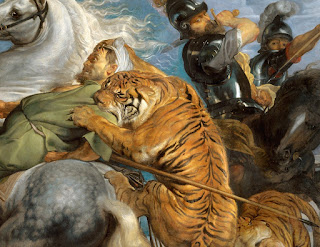
Rubens' Tiger Hunt (1616-17). The painter's concern
with the accurate physical representation of the tiger
is clear.


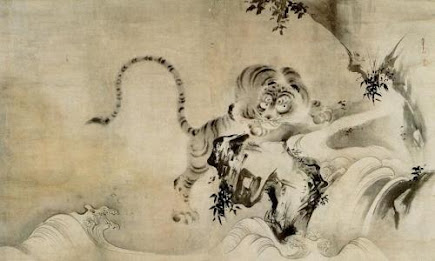
Knowing this suggests there may be more to Japanese depictions of tigers than meets the eye. At different periods, different styles are evident, but until relatively modern times, realism was not a primary concern. Certain features are repeated: the glaring eyes; the prominent eyebrows, the rhythmic line of the body, heavy paws, bristling whiskers and sinuous tail, and the stripes that both describe and break up the curves of the body. Rather than depicting a body of flesh and bone, many paintings seem to show a ripple of supple energy in a striped coat. 


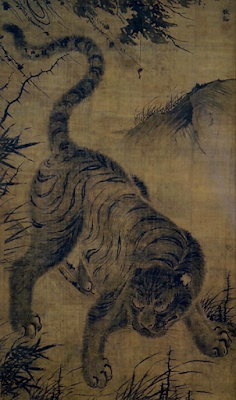
Kano Sanraku (1559-1635) A contemporary
of Rubens, but with different artistic concerns.


Kano Michinobu (1730-1790)
In this later work from the Kano school,
the spirit of the tiger seems quite different.


This may very well be a personal interpretation, and it might be misleading to see Japanese painters as having particular insight into the kinds of energies of interest to bugeisha without any further evidence. Tigers had a range of widely accepted symbolic meanings, some of which were certainly applied to the manners and attitudes of classical bushi. These included the ideas of preparedness (a tiger always sharpens his claws) and virtue (tigers keep their claws sheathed and hide themselves away in bamboo thickets, not outwardly displaying their prowess or threatening others), as well as power and ferocity, and it is highly likely that both the painters and their audience would have had no problem seeing the paintings as illustrative of these. (I discussed an example of this kind of symbolism here).

From Nijo Castle - a sharp-clawed tiger


There is another area where the symbolism would have been recognisable to members of the warrior class, especially the higher ranking members, and this is the realm of military strategy; in particular, military divination.


Military divination is an area that has seen little research among modern historians, tainted as it is with the whiff of superstition. Nonetheless, it was given serious consideration by those involved in warfare. The link with art comes through research into the work of the 16thcentury monk-painter Sesson Shukei (ca.1492-1577), and has only recently come to light.


Sesson was unusual as a painter; although he was highly accomplished, he did not work in nor had he ever visited the capital, Kyoto, but was based to the east, largely in the Kanto region around Odawara, another burgeoning cultural centre. Sesson travelled a fair bit, not that unusual for monks, from his birthplace in present-day Fukushima down to the Kamakura and Odawara area, and built up connections to several networks of learning, notably his Zen lineage and also the Ashikaga Academy, a center for studying Confucianism, medicine, strategy and I-ching divination, whose graduates often found employment from warlords as advisors, negotiators and diviners, skills that were much in demand in those unsettled times. Not all the roles were military – Confucianism was seen as an important tool of governance and experts who were well versed in these teachings were valuable – but military divination was also one of the valued skill sets.


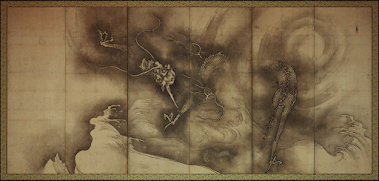
Sesson’s travels took him close to the academy, and several of his works are based on themes closely aligned to its Confucian teachings. It would not have been surprising if he attended lectures there. His mentor and possibly dharma master, Keijo Shisui, had known connections with the academy, while the head of the academy, Kyuka, served Hojo Ujiyasu, the powerful lord of Odawara (and rival of Takeda Shingen and Uesugi Kenshin) and it was for Ujiyasu that Sesson painted his screen painting, Dragon and Tiger, (now in the Cleveland Museum of Art. There is another by him or his studio in the Nezu Museum, Tokyo). 


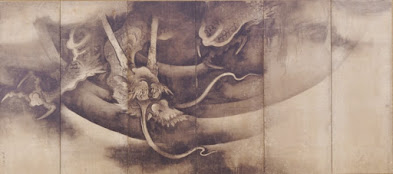
Sesson's Dragon (painted between 1546 -1556) -
perhaps the most human of dragons I have seen.
Note the powerful forces that swirl around the dragon,
obscuring and revealing its form. (click on the picture to see
a larger version)


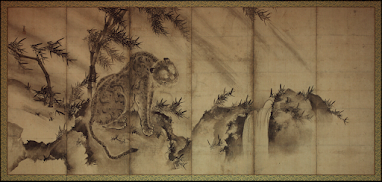
Sesson's Tiger may look playful (Sesson's distance from
the cultural centre, Kyoto, meant he 
did not have access to the more famous models
of dragon and tiger painting), but it crouches,
waiting patiently for the opportune moment,
resisting the strong winds all the while.


For an artist interested in philosophical concepts of being and nothingness and the mutability of form and phenomena, sumi-e is a particularly apt medium. It is hard not to imagine such an artist embuing his works with aspects of his learning in these areas. The art historian Yukio Lippit sees Sesson’s Dragon and Tiger as an explicit representation of this knowledge – in particular, they show the interplay of yin and yang as represented by the tiger and the dragon. For a student of the I-ching, the world is in a state of dynamic flux, constantly generating and regenerating. The dragon, Lippit explains, illustrates the spacial element: visibility and invisibility – “states of exposure and hiddenness”, calling to mind the constantly changing dynamic of advantage and strategic opportunity. The tiger shows the temporal element: waiting, reading the situation, knowing how to choose action or inaction. For men such as Ujiyasu, all this would have been readily understandable. Lippit goes on to suggest a similar connection in Kaiho Yusho’s dragon paintings, as well as other dragon and tiger screens of the Muromachi and early Tokugawa periods.


Kaiho Yusho (1533-1615). One of a pair of dragon paintings
from Kitano Tenmangu Shrine, Kyoto. Looming from
the mists, it suggests the interplay of the visible
and the hidden. Kaiho Yusho was from a warrior family
and maintained contacts among the powerful members of that class. 


All of this is fascinating to me, as I had always felt (or imagined?) these works to embody some kind of deeper understanding related to the mix of spiritual and martial teachings that were connected to the traditional bugei. As yet, there has been little work on this area – Lippit’s own work is very recent – but I look forward to discovering more. I recommend this lecture by Lippit from early 2021 for those who want to know more. (The observations on military divination that I summarised above begin around the 30 minute mark).

https://www.youtube.com/watch?v=voIECq_k1xE).


Friday, 31 December 2021

Happy New Year 2022 - Year of the Tiger


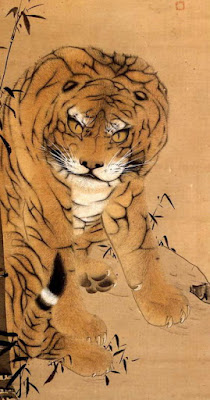
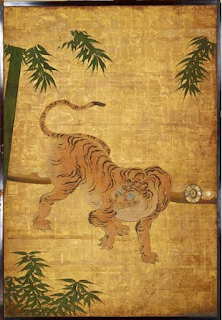
A rather friendly looking tiger from the Kano school


A Happy New Year to all my readers! 2021 has been a far less productive year than I had hoped, but fingers crossed that 2022 will be better. Japan having adopted a cross between the western and Chinese New Years, January 1st sees the start of the year of the Tiger, the perfect opportunity to take a look at tigers as the subject of traditional Japanese painting.

Tiger paintings have a long history in Japan, but the motif and much knowledge and lore concerning this most Asian of animals came from the mainland, especially China. Korea, of course, had a strong tradition of tiger painting, and this was also a major influence on Japanese artists.

Artists on the mainland had an advantage in that they may have had the opportunity to see live tigers. This was not the case in Japan, where the work of previous artists served as models. At least one famous artist (Maruyama Okyo) went as far as to buy the skin of a tiger to use as a model and this is probably as close to a real tiger as many artists would have come until the late C19th.

Japanese tigers come in many forms, and were used as a motif on hanging scrolls, folding screens and sliding doors, sometimes covering all four walls of a room. The necessary element of the imagination served to give the best of these images an impressive sense of energy and an identity and charm all of their own.  


This painting by Muqi, was the inspiration
for many later Japanese painters

The Chinese painter Muqi (Mokkei) (1210?-1269?) seems to have provided the initial models of tigers for Japanese artists. Not coincidentally, he also provided the first known example (in Japan) of the dragon and tiger motif. A Zen monk as well as a painter, Muqi seems to have been the master of a thriving atelier, and some of the work attributed to him may well be from the hand of painters who worked under him. His work was not regarded as highly in his homeland as it was in Japan - and the pieces held by the great Japanese Zen institutions of the time are among the finest examples of his work.


Not a great reproduction, but it shows the dragon
tiger pairing. You can also see the poetic lines about clouds
and wind at the bottom of each painting.


This pairing of the dragon and the tiger is rich in symbolism. Together, they represent the balance of forces in nature, the yang dragon in the sky also represents spring, while the yin tiger on the ground is a symbol of autumn. They are also associated with the clouds and wind respectively, and bamboo in the case of the tiger. This is an early association – the most famous pair of Muqi’s dragon and tiger paintings (see above) bear the lines ‘The dragon soars and brings the clouds; the tiger's roar, the ferocious winds’. The two creatures are always pictorially balanced, with the tiger at the bottom left (in early paintings this seems to be an invariable rule) and the dragon the top right. There is, too, the yin within yang and vice versa: although soaring in the clouds, the dragon has risen from the depths of the sea; similarly, while land bound, the tiger is associated with the mountains, and thus there is an acknowledgement of the opposite within each image. Both of them represent power, and they were often used to refer to well-matched opponents whose strength lay in different areas. A good example of this is the two well-known rival warlords, Uesugi Kenshin and Takeda Shingen, both among the strongest generals of the Sengoku period, though different in their personalities. They were known as the Dragon of Echigo and the Tiger of Kai.


Tigers pop up quite a bit in Zen, and this may help to explain why they became popular with Zen temples. As well as the works of Muqi, many of the earlier hanging scrolls and screens were painted by monk painters. The late Muromachi period saw the proliferation of professional painting studios, principally those of the Kano, who produced decorative schemes with whole rooms or suites of rooms being given over to tigers (amongst other motifs). These include the temples of Nanzen-ji, Manshu-in and Eikando in Kyoto, where they can still be seen in their somewhat faded but nonetheless impressive glory. These schemes were adopted from the warlords of the period, and it is easy to see why the military class would favor this symbol of power and control.


Nijo Castle - an old picture showing the original paintings. 
The virtuous, upright bamboo is clearly visible.


Nijo Castle in Kyoto offers a fine example of the warlords’ taste, although the original paintings are no longer in situ, having been replaced with newly painted copies. (I also wrote about this here: 
http://ichijoji.blogspot.com/2020/06The symbolism is not subtle and it is used in the service of power, both legitimizing and intimidating visitors to the rooms. The visitors would be visiting lords, and the intention was not only to awe them with the trappings of power and wealth, underlining the visitors' own vulnerability, but to reinforce the message with specific reference to the motifs in the decorations.

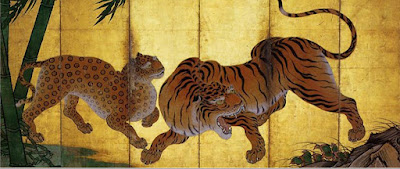
Nijo Castle - a male and female 'tiger'


While the tiger represents power and ferocity - military virtues - a ruler should also be virtuous, an attribute which is signalled by the bamboo, which grows upright and remains unchanging, true to its nature, throughout the seasons. It also possesses the flexibility required of a virtuous ruler. As well as tigers, we can also see leopards (which were thought to be female tigers) in some of the rooms. This was no accident, but a reference to mating and thus the continuation of the shogun’s line.


Nanzenji - although a Zen temple, it adopted the motifs of the military class.
Temples also employed the same artists. There may be a greater emphasis on
the peaceful nature of the tigers in the temple scenes, but I wouldn't bet on it.


The intention to intimidate is obvious in the case of the bushi class, but in the grand decorative schemes in Zen temples, the meaning is a little less apparent. As noted before, tigers do crop up in Zen writings: the enlightened man is likened to a dragon in the depths or a tiger in its mountain fastness, serenely confident and at ease in his own attainment. While this might do for personal contemplation, they were also a means of impressing visitors. Partly, this would have been allowing them the pleasure and privilege of seeing such fine works of art. It also served to underline the importance of the abbot (and his temple) in having access to the very best in artists - the same ones, in fact, that were employed by the highest and most powerful figures in the realm. Religious institutions, it must not be forgotten, were very much a part of the body politic, and their abbots were powerful figures.

There is much more to be said of tiger paintings, and in the next post I intend to look a little closer at some of the major styles in Japan, as well as a recently discovered and deeper role in the arts of war.


More about this one in the next post.